Who Will Beat the Odds in Las Vegas?
This week’s newsletter dives into the Las Vegas Grand Prix – Formula 1’s ultimate gamble – where long straights, cold air, and neon lights meet pure unpredictability. Built for spectacle but ruled by chance, the Strip Circuit has already become one of the most chaotic races on the calendar, and the data shows why.
At a Glance
- Setting the Stage
- Quantifying Chaos
- The Flow of Chaos: Vegas in Motion
- Predicting the Wild Card
- The Race Recap
- The State of the Grid
- Looking Ahead: Qatar
Setting the Stage
Formula 1’s return to the Las Vegas Strip is more than just a race, it’s a spectacle built for chaos. In just two appearances, the Grand Prix has already delivered the kind of drama that defines seasons. Safety Cars, collisions, and late-race comebacks have turned each edition into a highlight reel of unpredictability.
The inaugural 2023 race saw a relentless duel for survival on the cold, slippery streets, while 2024’s sequel flipped the script entirely, where strategy, not speed, determined the outcome as track temperatures plummeted and grip vanished. Both races shared one thing: not even the best simulations could predict the finish.

Now, as Formula 1 returns to the neon heart of Nevada, the question remains. Will it be brilliance, bravery, or blind luck that wins under the lights this time?
Quantifying Chaos
We brought back the Chaos Meter this week, the same measure we used in our Brazil story to show which races produce the biggest shakeups between start and finish.
Instead of looking at speed or pit stops, this metric focuses on movement, specifically how much the finishing order changes during a Grand Prix. The more drivers swapping places, the higher the chaos score.
Back in São Paulo, it revealed why Interlagos has long been F1’s “chaos circuit.” But for the first time, another track has matched it. Las Vegas now ties Brazil for number one, meaning it’s statistically one of the most unpredictable races on the calendar.
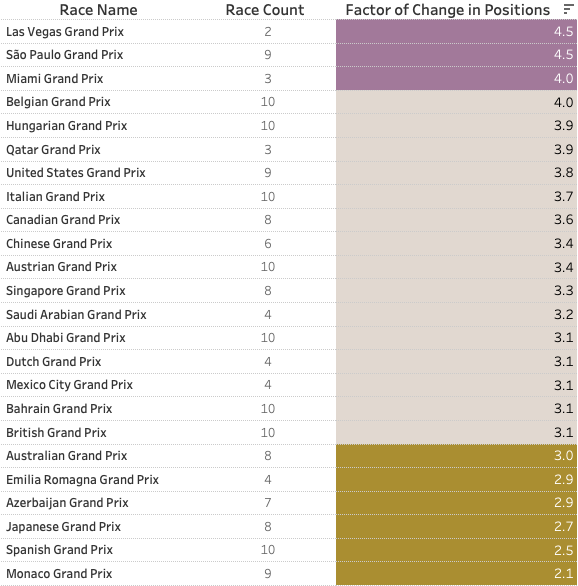
In simple terms: no race keeps the leaderboard moving like these two. Pole positions vanish, strategies implode, and anyone on the grid can end up in the spotlight by the final lap.
Vegas hasn’t been around long, but the numbers already prove what every fan watching under the lights has felt. This is a race where control is an illusion, and fortune favors whoever can keep their car pointed straight when the rest of the field starts to spin.
Be sure to also check out our Instagram site for regular updates and posts on our F1 coverage.
The Flow of Chaos: Vegas in Motion
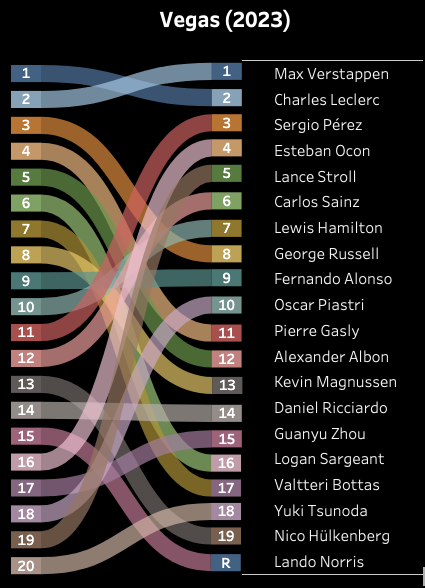
If the Chaos Meter shows how unpredictable Las Vegas is, the positional-flow charts from the first two races show why. The visualizations below map every driver’s journey from the start grid to the checkered flag in 2023 and 2024, turning each Grand Prix into a live portrait of movement, momentum, and mayhem.
In 2023, the lines twist sharply across the field as this was a race defined by early incidents, Safety Cars, and sudden swings in pace. Midfield starters surged into the top ten, while several front-row contenders slipped backward as the track cooled and grip disappeared. Nearly every driver changed position multiple times, creating a tangled web that looks more like a subway map than a standard race progression.
2024 paints a different kind of chaos. Here, strategy, not accidents, drove the reshuffling. Tire choices split the field, with some drivers gaining ground steadily through long first stints while others tumbled down the order late. Even without major crashes, the order never settled. Lines weave forward and backward as the lap count rises, showing just how volatile pace and degradation were under the desert lights.
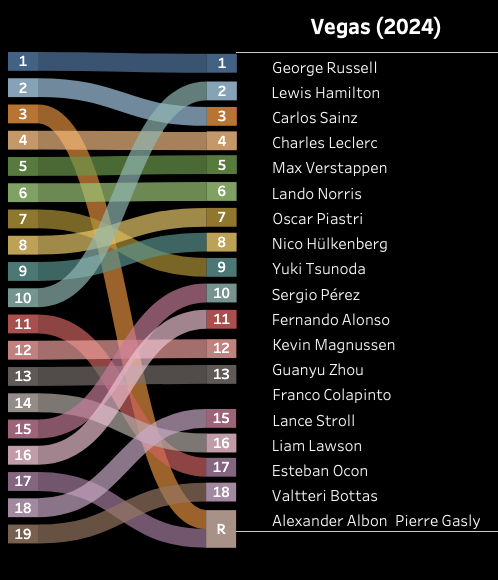
What stands out most in both visuals is just how little stability Vegas offers.
Across two completely different races, no part of the field remained static. Not the leaders, the midfield, or even the backmarkers. Every stint brought new winners and losers, and every restart or pit cycle cracked the race wide open again.
This is why Vegas sits at the top of the Chaos Meter alongside Brazil:
it’s a circuit where nothing holds, and where every driver, fast or slow, is one moment away from a surge or a collapse. Under the glare of the Strip, positional order is just a suggestion.
Predicting the Wildcard
To understand which drivers are best equipped to handle Las Vegas’s volatility, we turned again to our Drive Score metric – a composite rating that measures how effectively a driver converts their starting position into a finishing result by tracking total positions gained or lost. For this race, the model was recalibrated using every street-style circuit on the 2025 calendar including Miami, Saudi Arabia (Jeddah), Azerbaijan (Baku), Monaco, and Singapore, all of which share the low grip and evolving conditions that define the Strip.
Across these street-style events, a clear pattern emerges at the top of the field. Lando Norris has been the strongest performer on street circuits this season, with Oscar Piastri close behind through consistent gains and strong qualifying results. Max Verstappen and George Russell follow as reliable movers when conditions get tricky, while Charles Leclerc rounds out the group with steady race-day progress in tighter, low-grip environments.
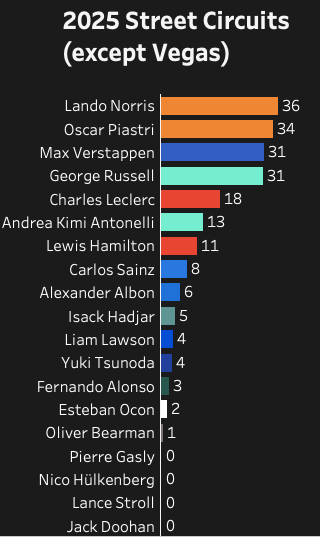
But the full picture at Las Vegas involves far more than just the front runners. When we map Drive Scores across all twenty drivers, the spread shows a wide range of adaptability on street circuits, highlighting who tends to rise as conditions change and who struggles when the order becomes fluid. It’s a reminder that on a track like the Strip, where unpredictability shapes every stint, the entire field is part of the story, not just the usual contenders.
Want to learn how to analyze data and build amazing data stories? Join Data Punk Media today!
The Race Recap
Las Vegas delivered another spectacle under the Saturday night lights, trading F1’s usual Sunday chaos for a primetime showdown on the Strip. Qualifying set the stage for a dramatic evening: Lando Norris stormed to pole with one of his strongest laps of the season, followed by Max Verstappen, Carlos Sainz in a stunning P3 for Williams, George Russell in fourth, and Oscar Piastri in a frustrating fifth after a difficult qualifying session.
When the lights went out, everything unraveled for McLaren immediately. Verstappen launched perfectly off the line, and as Norris moved across to defend, he ran deep, slid off track, and handed the Red Bull the lead before Turn 1. Russell slipped by soon after, dropping Norris to third. Behind them, both the Racing Bulls of Isack Hadjar and Liam Lawson jumped past Piastri, knocking him down to seventh. In two corners, both McLarens had lost the advantage they earned the day before.
The early laps were defined by contact, debris, and rapid movement through the field. Lawson suffered front-wing damage, which allowed Piastri to reclaim sixth. Lewis Hamilton, starting deep in P19 on hard tyres, sliced through the midfield in the opening chaos, reaching P12 within two laps. A virtual safety car on Lap 2 slowed the field as Lawson pitted and marshals cleared debris. Once racing resumed on Lap 4, DRS was enabled and the first real strategy patterns began to emerge.
As the mediums began to fade, the race started to take shape. Leclerc climbed steadily, passing Bearman for P7, then Piastri for P6, then Hadjar for P5 in a brilliant sequence of measured overtakes. Antonelli picked up a five-second penalty for a false start, and a second virtual safety car – triggered by contact between Albon and Hamilton – reshuffled the midfield yet again.
Strategy became the defining factor through the middle stint. Russell, reporting heavy steering issues, blinked first and pitted on Lap 18. Piastri followed on Lap 21, then Norris on Lap 23, and finally Leclerc and Verstappen on Lap 25, each switching to hard tyres for the run to the finish. Verstappen narrowly held the lead over Russell as he exited the pit lane, and once the first round of stops cycled through, the order settled to: Verstappen, Russell, Norris, Antonelli, Piastri, Leclerc, Sainz, Hadjar, Hülkenberg, and Hamilton.
With clean air and a lighter car, Norris began his charge. On Lap 34, he overtook Russell for P2 and set off after Verstappen, but the Dutchman’s pace was untouchable. For 16 laps, Norris chipped away, but the gap never meaningfully closed. Verstappen controlled the race to the finish, crossing the line in 1:21:08.429, more than 20 seconds ahead of Norris. Russell completed the podium, with Antonelli fourth on track before his penalty dropped him behind Piastri, promoting the Australian into the top four.
And then came the twist no one saw coming.
Early Sunday morning, both McLaren drivers – Norris and Piastri – were disqualified after post-race checks revealed the rearmost skid plank on each car was below the minimum thickness. The infractions transformed the final standings: Verstappen kept his win, but Russell moved up to P2, Antonelli inherited P3, Leclerc climbed to P4, and Sainz secured P5 for Williams in one of the team’s strongest weekends of the season.
In true Las Vegas fashion, the order on Saturday night wasn’t the order on Sunday morning. Just another reminder of why nothing in this city is decided until the final call.
Join Data Punk Media today and explore the different data stories we publish.
The State of the Grid
Driver's Championship
With only three scoring opportunities left including, the Qatar sprint, the Qatar Grand Prix, and the season finale in Abu Dhabi, the Drivers’ Championship has tightened into the closest three-way fight of the year. And Las Vegas only intensified the pressure.
On track, it looked like the standings were about to stretch apart. Max Verstappen’s dominant win should have brought him from 341 to 366 points, Lando Norris’s second place would have extended his lead to 408, and Oscar Piastri’s fourth-place finish would have moved him to 378, setting up a staggered but stable run into the final rounds. Then came the disqualifications.
With both McLarens removed from the results after post-race checks, the entire shape of the championship changed overnight. Norris stays frozen at 390 points, losing what should have been a crucial buffer heading into the desert. Piastri drops back to 366, now tied with Verstappen, who walks away from Vegas as one of the biggest beneficiaries of McLaren’s setback.
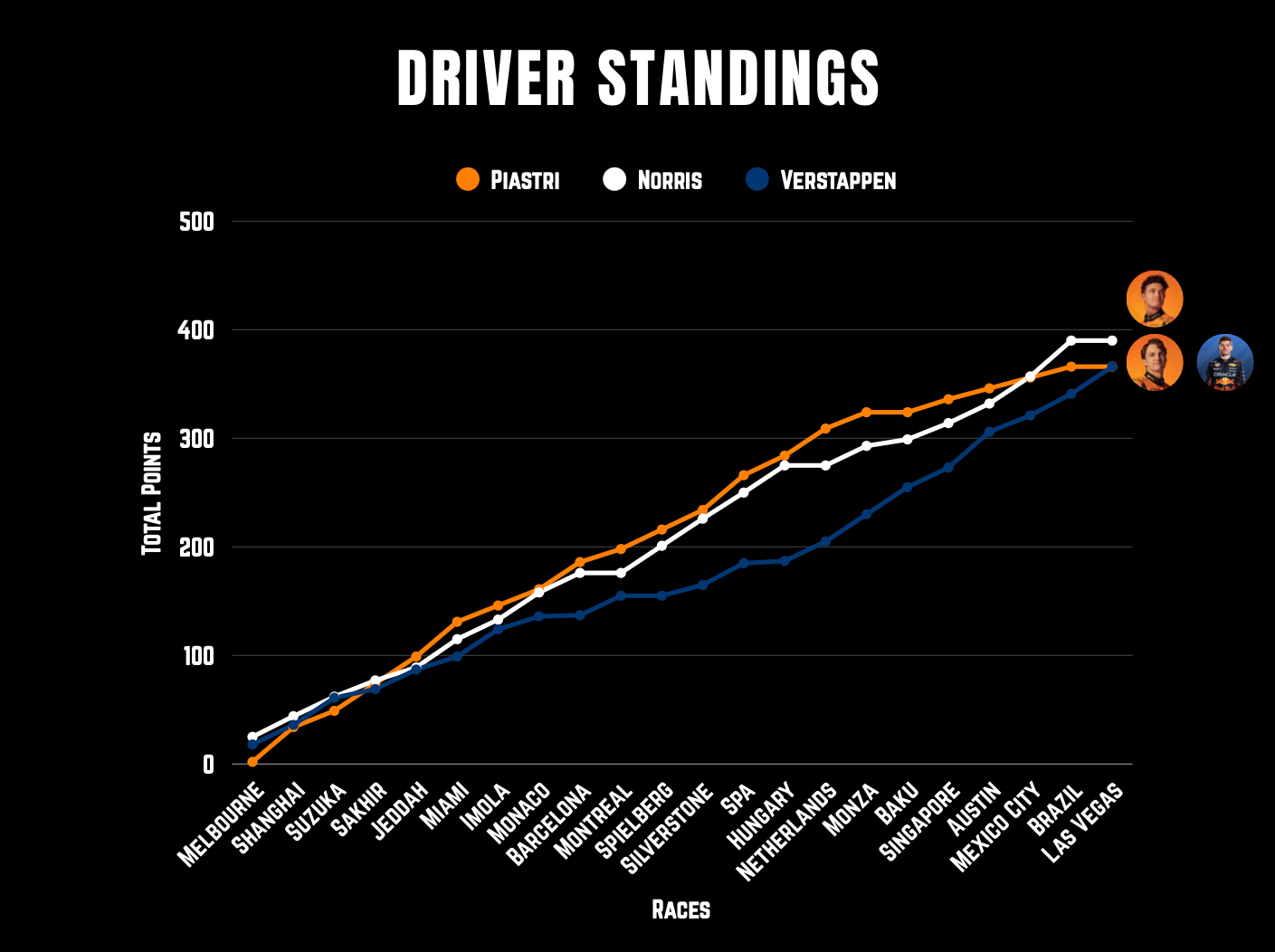
Three drivers.
Twenty-four points apart.
Three scoring sessions left.
Norris still leads, but the margin is thin, and the swing potential in Qatar’s sprint alone could rewrite the order before Sunday even arrives. Verstappen’s form is rising again. Piastri remains close enough to strike. And with Abu Dhabi looming, the championship has gone from a controlled chase to a genuine toss-up. What seemed secure for McLaren just days ago is suddenly wide open.
Constructors' Championship
McLaren may already have the Constructors’ title sealed, but Las Vegas proved just how fortunate they are to have built such an enormous cushion early in the season. Their double disqualification means the team remains at 756 points, a rare weekend where nothing went right and nothing added to their total.
Behind them, however, the battle for second has erupted into one of the tightest and most dramatic fights of the year.
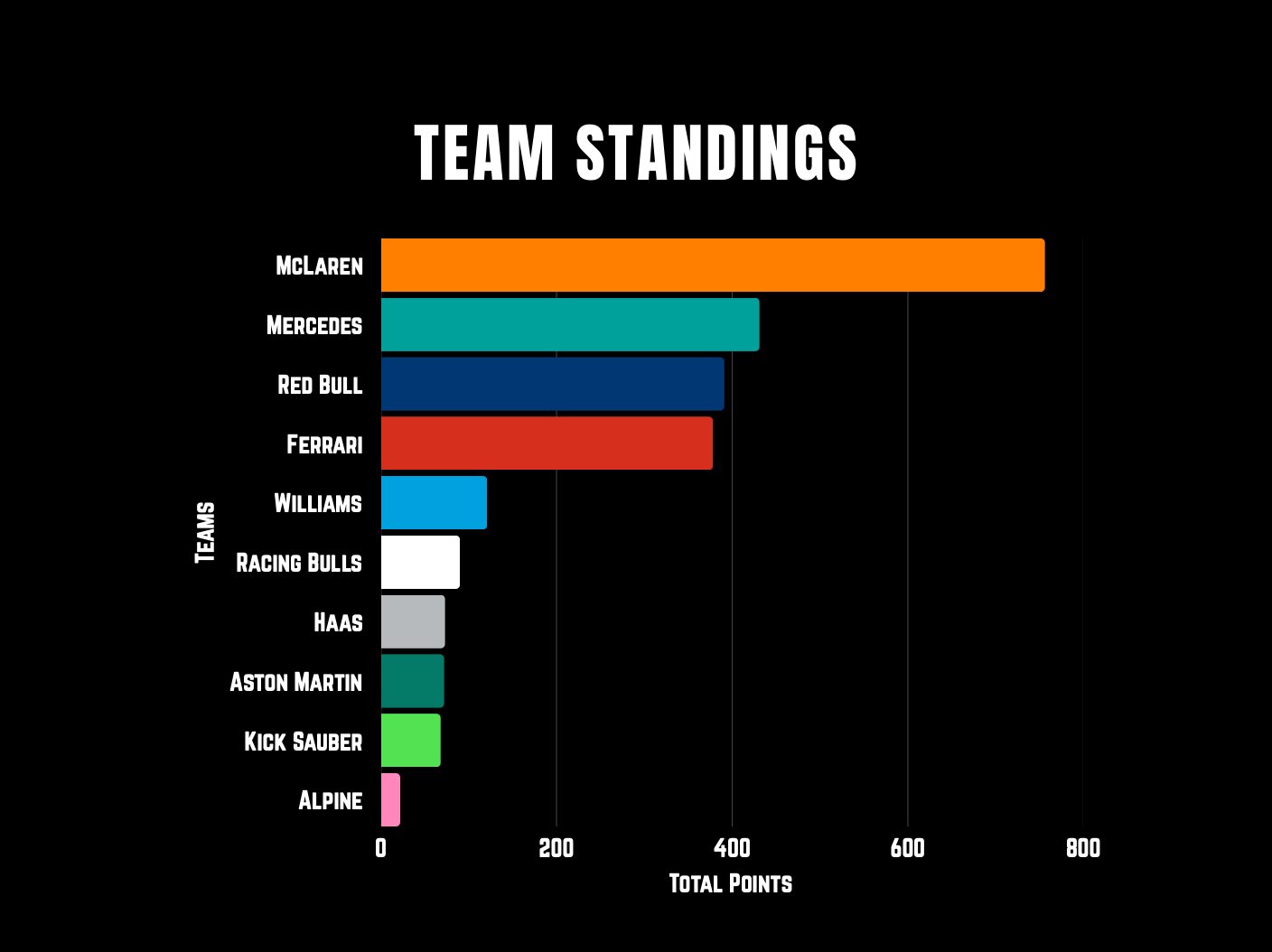
With George Russell promoted to second and Kimi Antonelli elevated to the podium, Mercedes walked away from Vegas with a massive 33-point haul, pushing their total to 431. It’s the kind of result that doesn’t just strengthen their hold on second place, it transforms them into the clear favourites to finish runner-up in the standings.
Red Bull, once again powered solely by Max Verstappen, added only 25 points, bringing them to 391, now 40 points behind Mercedes. The gap is surmountable on paper, but Verstappen cannot close it alone much longer. The team’s inability to consistently score with both cars remains their biggest vulnerability.
Ferrari, meanwhile, executed one of their strongest collective drives of the season. Starting deep in the pack, both cars fought forward aggressively, with P4 for Leclerc earning 12 points and P8 for Hamilton adding another 4, giving the team 16 points on the night and raising their total to 378. They now sit just 13 points behind Red Bull, suddenly within striking distance for third.
With a sprint and two full Grands Prix left on the calendar, nothing about this battle is settled. Mercedes has momentum, Red Bull is leaning on one driver, and Ferrari is closing in fast.
Three teams.
Two races.
One coveted runner-up spot still wide open.
Be sure to also check out our Instagram site for regular updates and posts on our F1 coverage.
Looking Ahead: Qatar
From Las Vegas we head to Qatar, where the spotlight turns to F1’s standout rookie, Kimi Antonelli. He arrives at Lusail with one of the strongest debut seasons of any active driver. Strong enough that his early form is already drawing quiet comparisons to another young Mercedes driver who reshaped the sport from the moment he arrived. Qatar’s high-speed, high-deg layout will test just how real that trajectory is.
It also matters for Mercedes. After slipping back post-2021, the team is finally showing signs of recovery in 2025, and Antonelli’s rise has become a major part of that momentum. The question now is simple: is Antonelli the breakout driver Mercedes has been waiting for, or is it too early to tell?
Qatar won’t decide the season, but it will offer the clearest look yet at where Antonelli and Mercedes are headed next.