
In this lesson, we'll introduce you to a key source where you can download and analyze NHL prospect data.
Home | Lesson 1 | Lesson 2 | Lesson 3 | Lesson 4 | Lesson 5
Getting the NHL Prospect Data
If you're like us, you're always on the hunt for good sports data sources. Unfortunately, free ones come and go and paid ones require a commitment – sometimes an expensive one. And hockey is no different from other sports.
Further, getting comprehensive data at the minor league level is no easy task. A good start, though, is Elite Prospects (EP).
EP has a ton of hockey data and information with coverage that extends well beyond the NHL. Getting access to the data API is not easy, but with a bit of 'copy and paste' you can quickly get some summary data into a spreadsheet and get busy analyzing.
The EP Draft Report
Each year, Elite Prospects distills their scouting reports into a single NHL Draft guide that includes quantitative and qualitative ratings of the top prospects. For the hockey nerd, it's an amazing source of information for the incoming prospects.
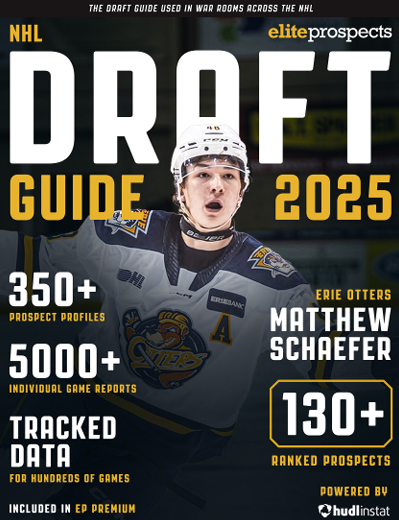
However, if you wanted to distill their data and reporting into a single, ranked list and then do your own analysis, you need to get the data into a spreadsheet so you can do the analysis. The EP Draft Center is a good first step to get updated statistics on NHL prospects for such an analysis.
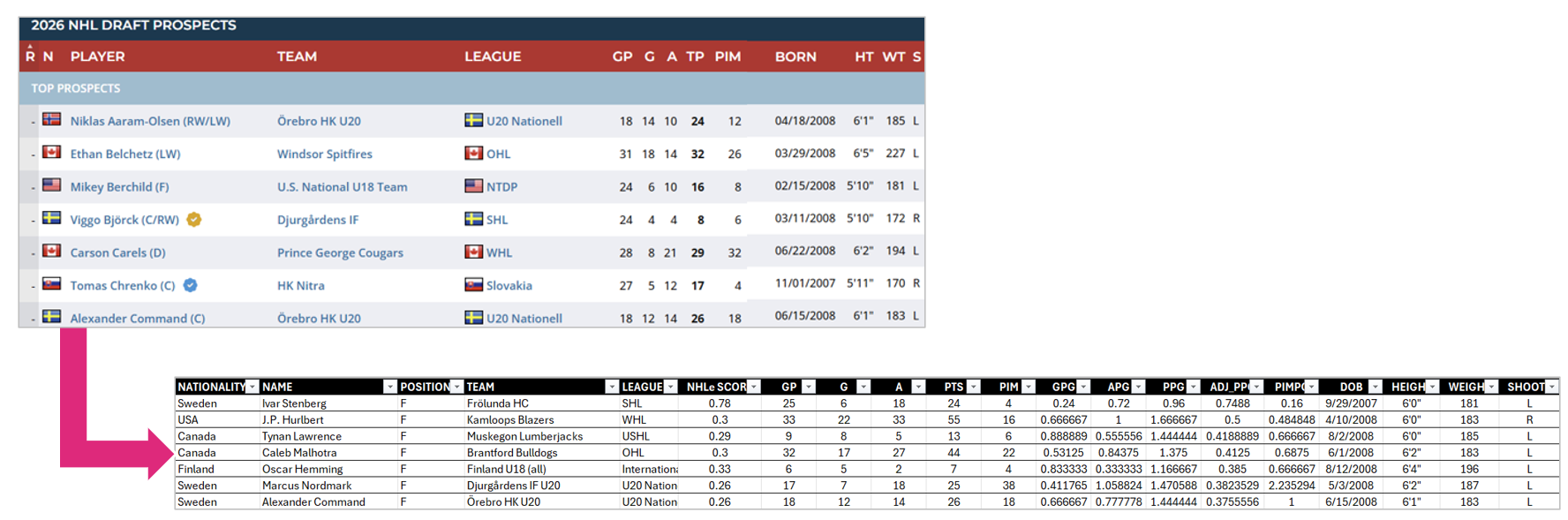
You can save yourself the hassle of the copy, paste and transformation and download the sample dataset for this module from here.
About the Data
The unit of observation in the dataset (rows) are players, and we've captured the top 100 players from the EP site (inclusive of forwards, defensemen and goalies). The variables (columns) are a mix of player metadata (such as Nationality, Name, etc.) and statistics (raw and calculated). Unfortunately, minor league player stats are not as comprehensive as the NHL's statistics, but you can do quite a bit with just a handful of raw statistics.
Once you have your data downloaded, you are now ready to move on to the next phase: conducting your analysis.
What Now?
With a clean dataset now in hand, you are ready to do an analysis. Keep in mind that this dataset is a 'snapshot', so it's a point-in-time view of the prospect data. If you want to have an updated or daily view on the prospects, then you'd need to build a predictable data pipeline; however, since we're doing a one-off story, it's okay that this is a snapshot.
Okay, on to the next step.
👉 Up Next? Lesson 3: Stats and Methodology