Wrapping up our third module in the Sports, AI and Storytelling course with an analysis of where our analysis went wrong.
Introduction
The Four Nations Face-Off laid the groundwork for our coverage of this year's Olympic hockey – specifically, the Men's Olympic hockey tournament. It also was the impetus for our third module in our Sports, AI and Storytelling Living Course entitled Discovering Who Will Win the Gold Medal for Men's Hockey.
Our focus in this course is about how you can weave numbers with AI and sports to create intereating stories. Unfortunately, in the aftermath of the gold medal game, the narrative has been less on stats and more on politics. While politics can be a legitimate angle for sports stories, there's a ton of fatigue out there on the current toxic and divisive nature of politics. So, while that could be a story angle, we're going to leave the political punditry out of our wrap-up here and focus on two items that will help us reframe our story:
- Three factors that influenced the outcome of the gold medal game (and why our analysis was wrong); and
- How you might accommodate for some of these factors as you build your own analysis and predictive model.
Let's get to it!
Interested in Sports, AI and Storytelling? Check out our Stories page, where you'll find projects to help level up your sports storytelling skills.
The Factors We Missed
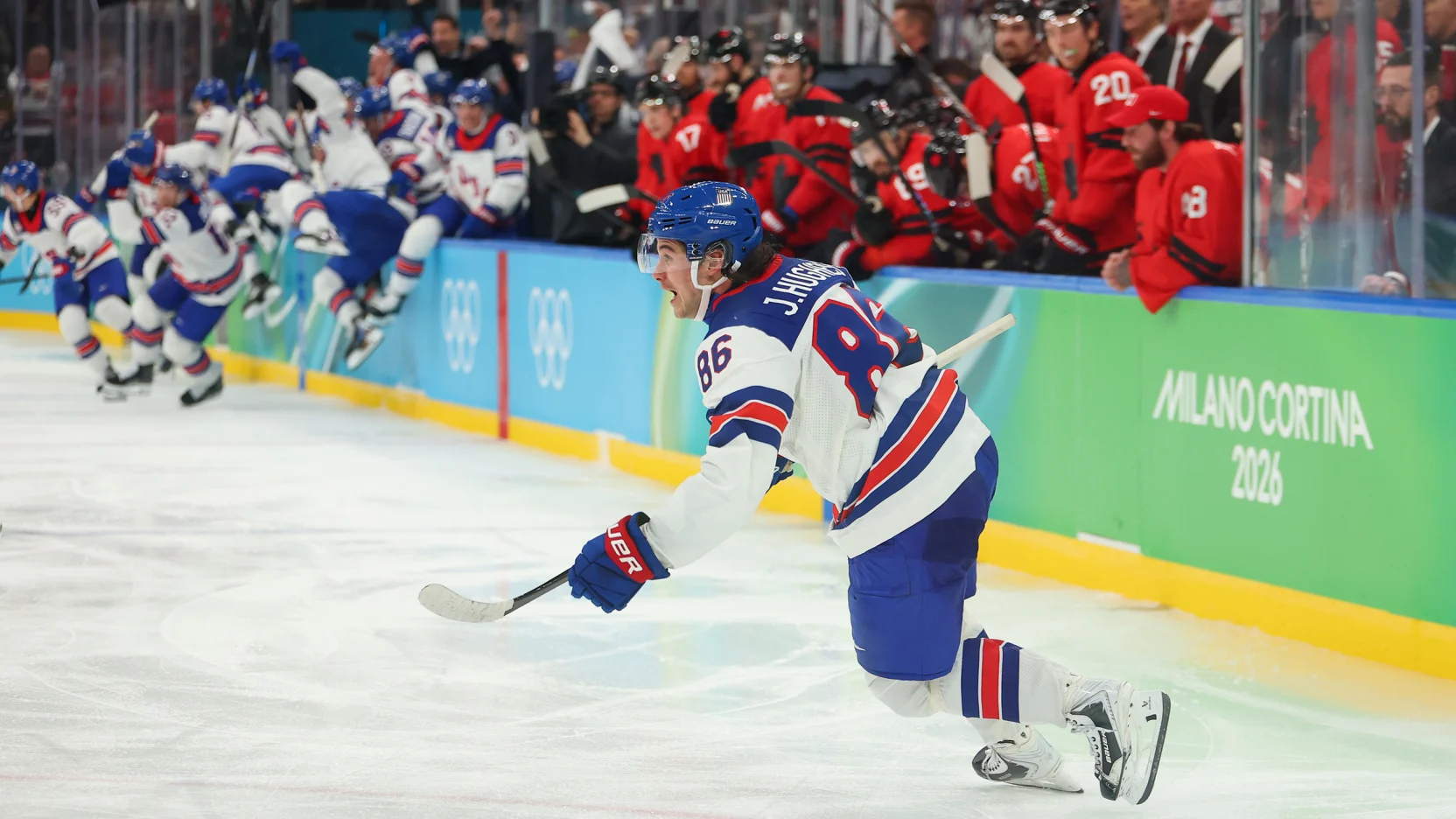
The Olympics medal round came to its conclusion, and while we were right in our prediction about Canada meeting the USA in the Gold round, we were wrong in our prediction that Canada would take home the Gold. Team USA defied both our forecast and the recent odds from the sports books and took the gold medal.
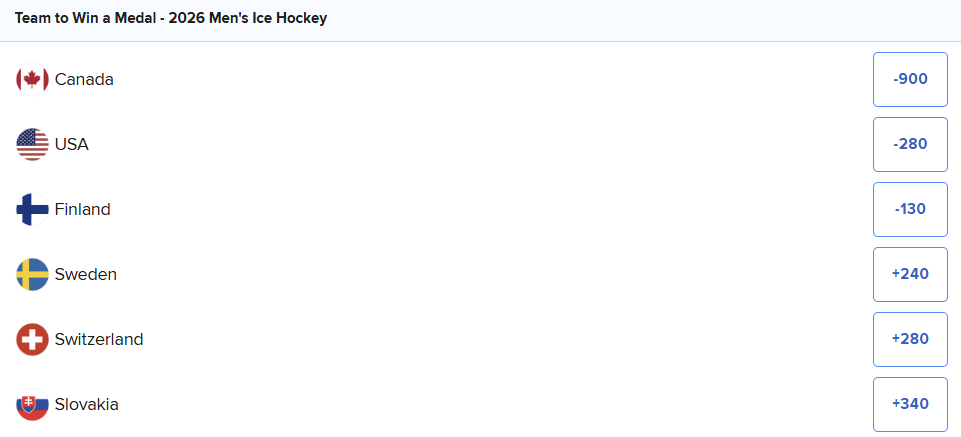
The result? Team USA won in overtime by a score of 2-1 with Jack Hughes scoring the game-winning goal. The NHL had this to say:
...he scored one of the most dramatic goals in Olympic hockey history, 1:41 into overtime to give Team USA a 2-1 win against Team Canada...The goal, off a pass from Zach Werenski during 3-on-3 play, slid through the five-hole of Canada goalie Jordan Binnington and delivered the much-awaited gold medal for this American squad, placing it on the same pedestal as the 1980 “Miracle on Ice” team.
So, where did we go wrong?
In our analysis, we evaluated the teams across five key areas and ranked the teams first and second based on the metrics. The five metrics were Puck Possession, Shot Capabilities, Point Production, Physicality, and Goaltending.
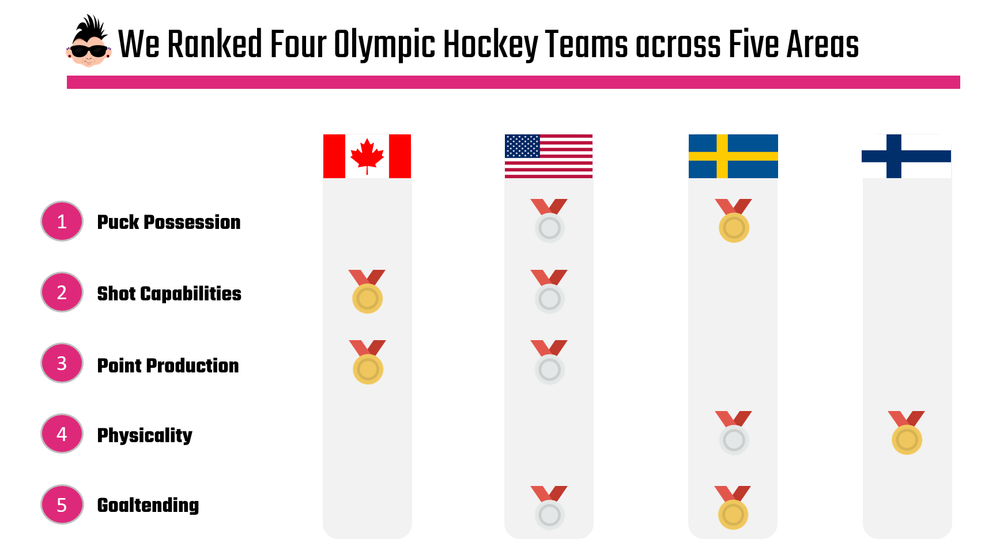
We also used NHL player and goalie data to evaluate the four teams that participated in the Four Nations Face-Off (often heralded as the four top medal contenders in the Olympics).
However, there were three significant variables that factored into Team USA's win.
- Sidney Crosby was out of the lineup because of an injury during the game with Czechia.
- Hellebuyck stood on his head in net.
- Team Canada missed key opportunities to score.
There's been a lot of fog and commentary around the 3-on-3 overtime format of the Olympics, but while this might have been a factor, teams knew it was coming so should have been training for it. A 3-on-3 overtime gives players way more space, which for the world's best hockey players is super dangerous. The game of hockey is about creating space, so when you have it there is more time to wield your skills. And when it happens, it's quick – and in this case devastating.
But, let's jump back to the three variables that we "missed."
Losing Sidney Crosby
First, losing Sidney Crosby was not just an impact to point production, but it must have been a moral loss as well. Crosby is a superstar and a leader in the NHL. He was also Team Canada's captain. We did a point-in-time analysis, which didn't account for injuries.
Team USA's Goaltending
Second, Hellebuyck played absolutely stellar. In fact, for more than half the game Canada had Team USA on their heels. They continually pressed in the offensive zone, but Hellebuyck was a key variable that held up to their pressure. Here's an amazing photo of one save that Fox News characterized as heroic with his "miracle stick."
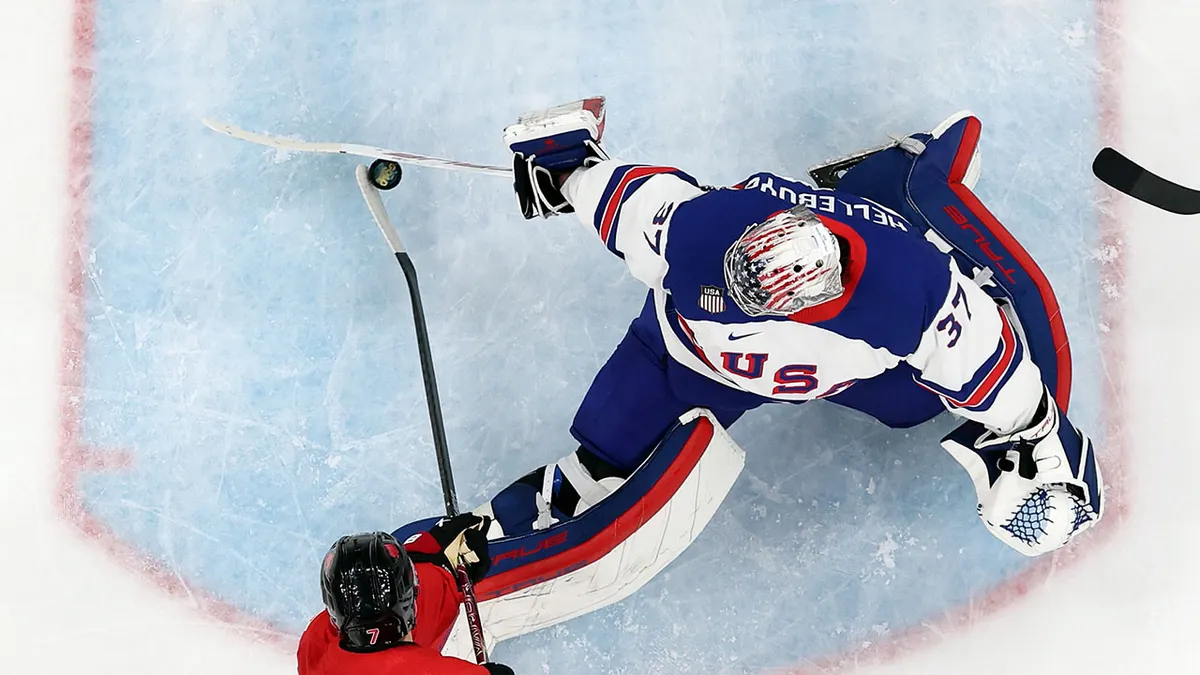
And it's not just the saves that impact the scoreboard; not being able to convert through their pressure must have been both frustrating and exhausting for Team Canada.
Missed Opportunities
And third, Canada had multiple missed opportunities that would have tilted the game in the opposite direction. Today's game was a game of millimeters, bouncing pucks and odd calls and rules. But like it or not, that's hockey.
All told:
- The data told us that Crosby was a significant contributor to the success of Team Canada. But it didn't tell us that there'd be an awkward check that would take him out of the tournament. This made a difference.
- The data also told us that Team USA's goaltending was good – and with strong attribution to Hellebuyck. So, we knew he was good. But, he was outstanding in the medal game. This made a difference.
- Finally, the data also told us that Team USA were second to Canada in terms of point production. And when comparing Shots on Goal (SOG) - 42 to Canada to Team USA's 28, the difference was significant. What made the difference here was Hellebuyck.
So, in sum losing a team captain, a goalie having a stellar game and unlucky bounces were key differentiators in this game.
We've posted all the data and analysis code on our Data Punk Media GitHub repo.
How Would We Change Our Approach?
When it comes to the analysis, as we mentioned earlier it was a point-in-time analysis – one that we did prior to the start of the Olympics. So, it wasn't a predictive model, so to speak; it was more a directional analysis. But, if we were to it differently, how might we roll?
From an analysis perspective, we might have only focused on Shot Strength, Point Production, and Goaltending. This would remove our custom metrics out of the mix and only focused on a core set of tried and true hockey statistics. And while the analysis might have been cleaner, we're not sure that it would have made a huge difference.
Second, we would have used the analysis as a baseline and built a predictive model that we'd update after each game in the Olympics. This would have been an additional step, but it would have given us 1) a baseline (initial analysis) and 2) a predictive model (updated each day).
This may be obvious, but it's important to note that when you're building predictive models, it's not a one-and-done affair. You take your dataset and algorithm (i.e., your approach) and you run the model and update the numbers after every game. As you do this, the updated model refactors dynamically based on who's in and who's out (you exclude injured players in the updated models). (You can also add a 'weighting' based on over- or under-performance by a team based on how they're playing.) Updating the model after each game would have changed with Crosby not being in the lineup. For example, if you use Win Probability as a key predictor, the average would have been lower with Crosby out of the lineup – which changes the prediction.
So, What is the Story?
We spent a lot of time here and in the run-up to the tournament created more of a learning instrument rather than a story. This gives you a specific view of what data we had going into the event. You can see the carousel slides below.
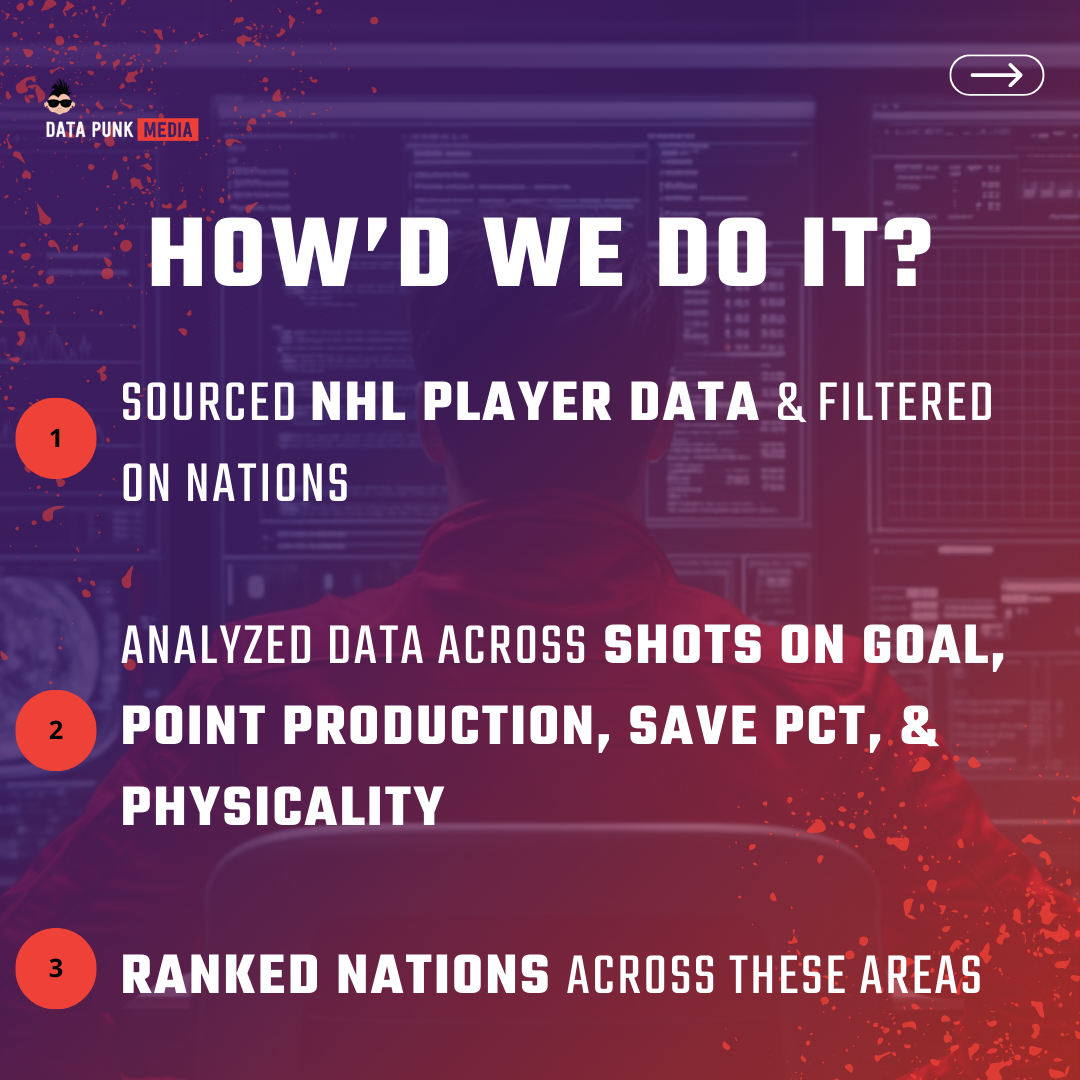
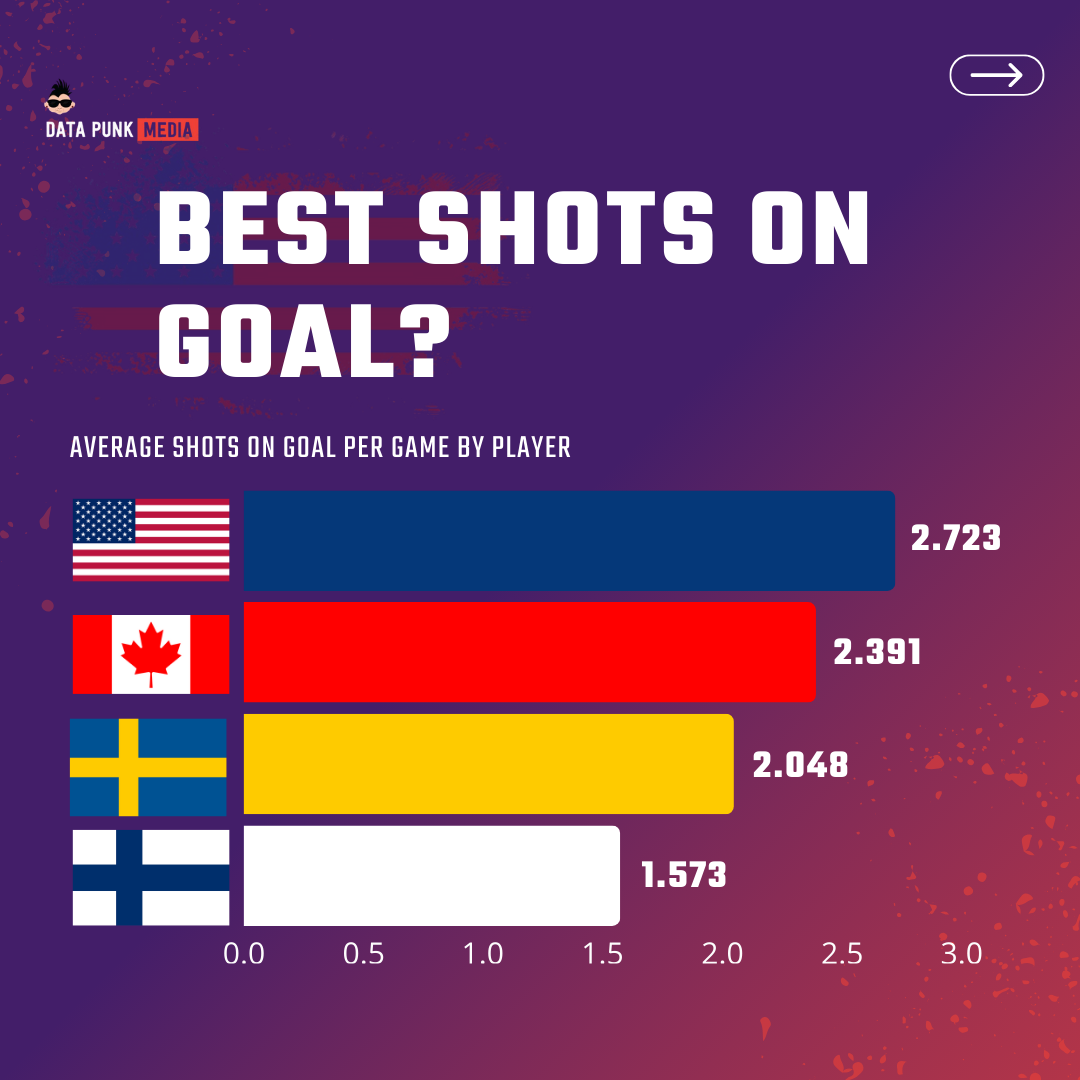
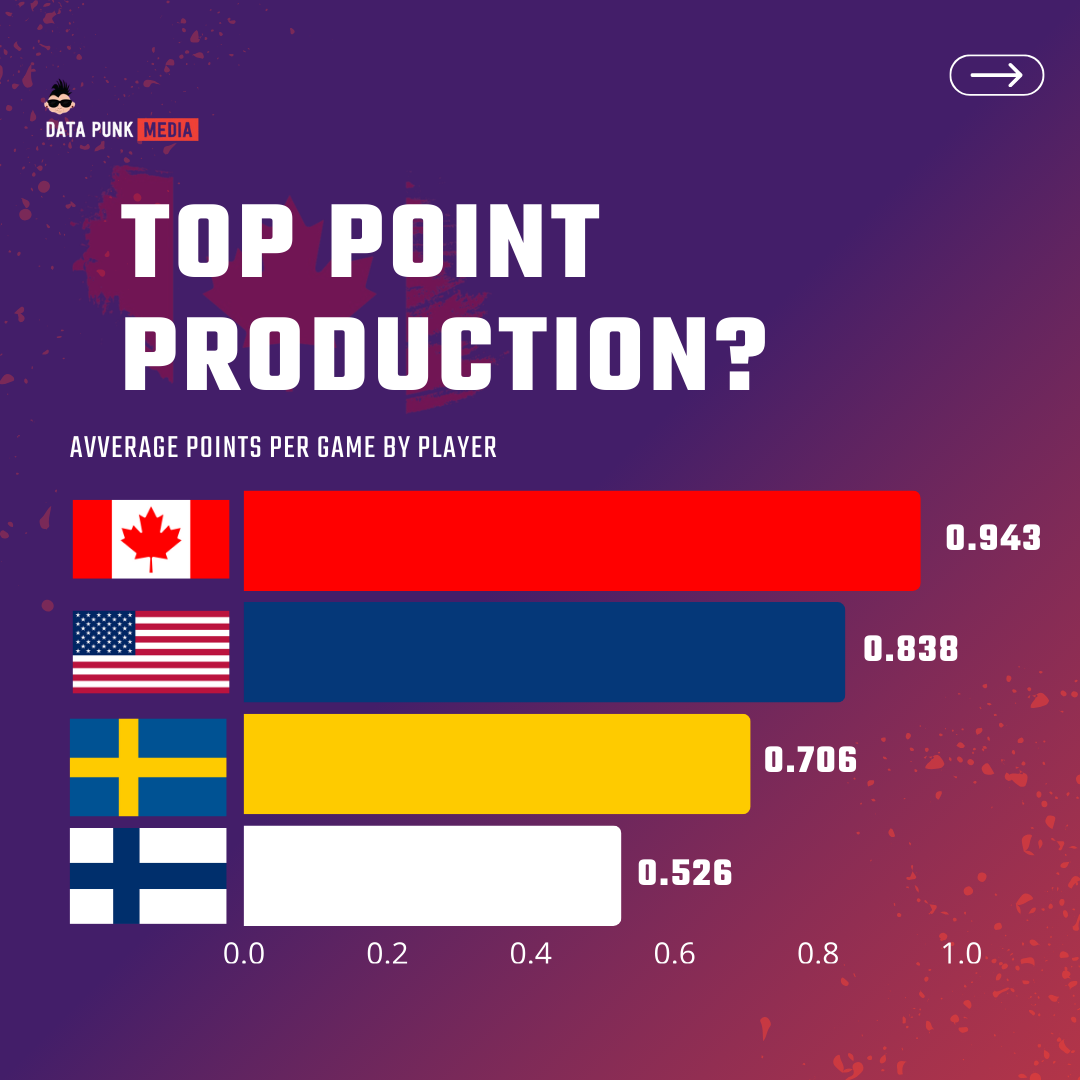
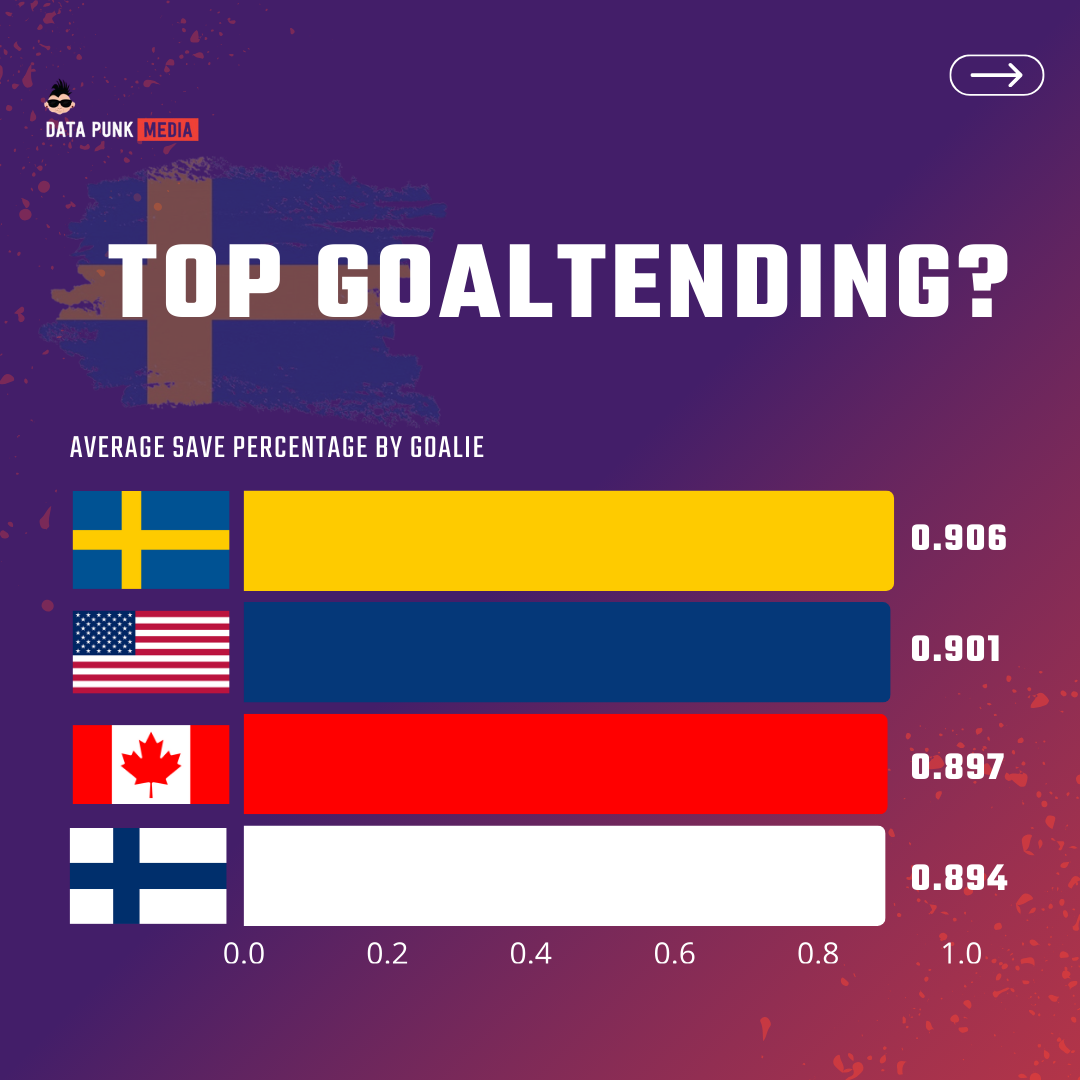
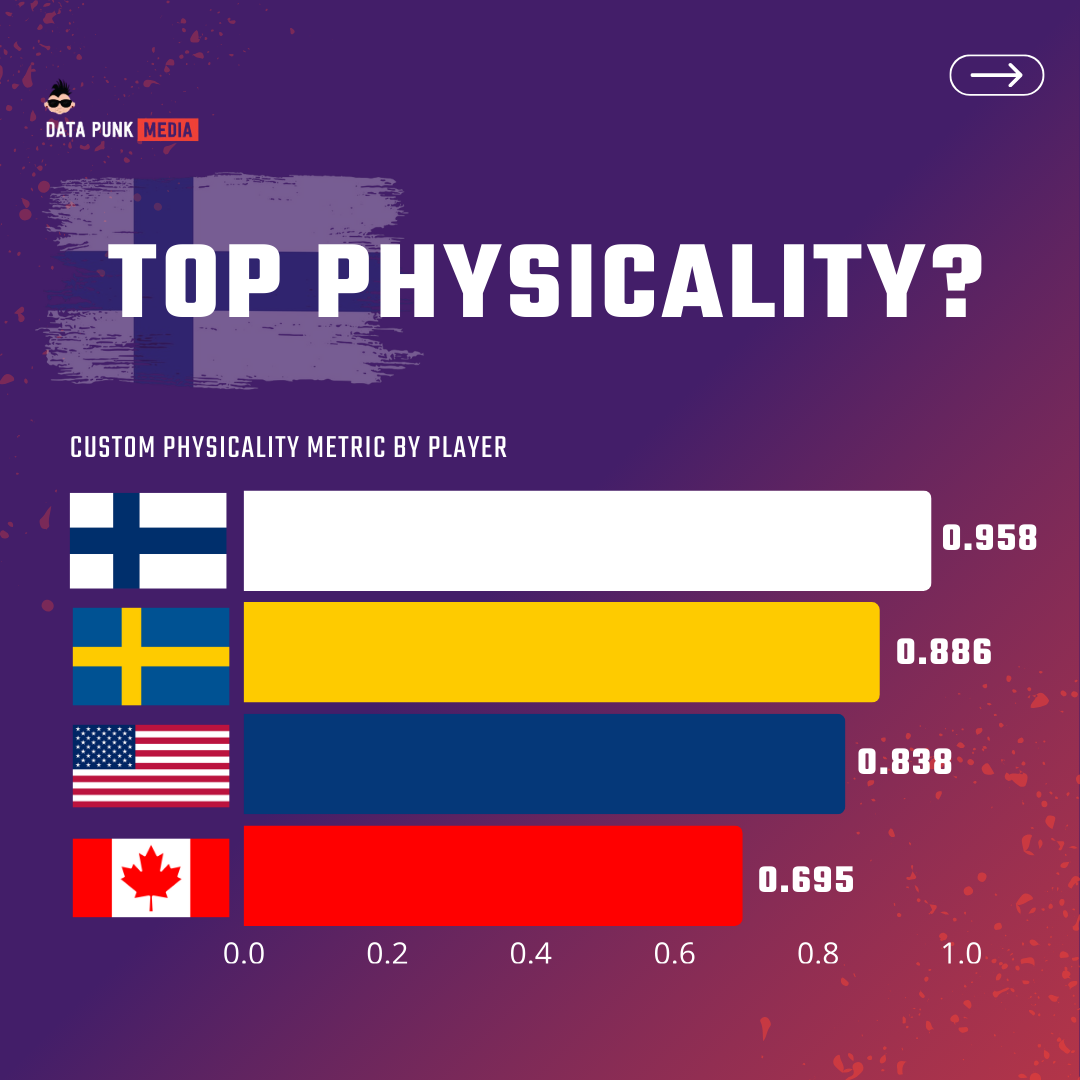
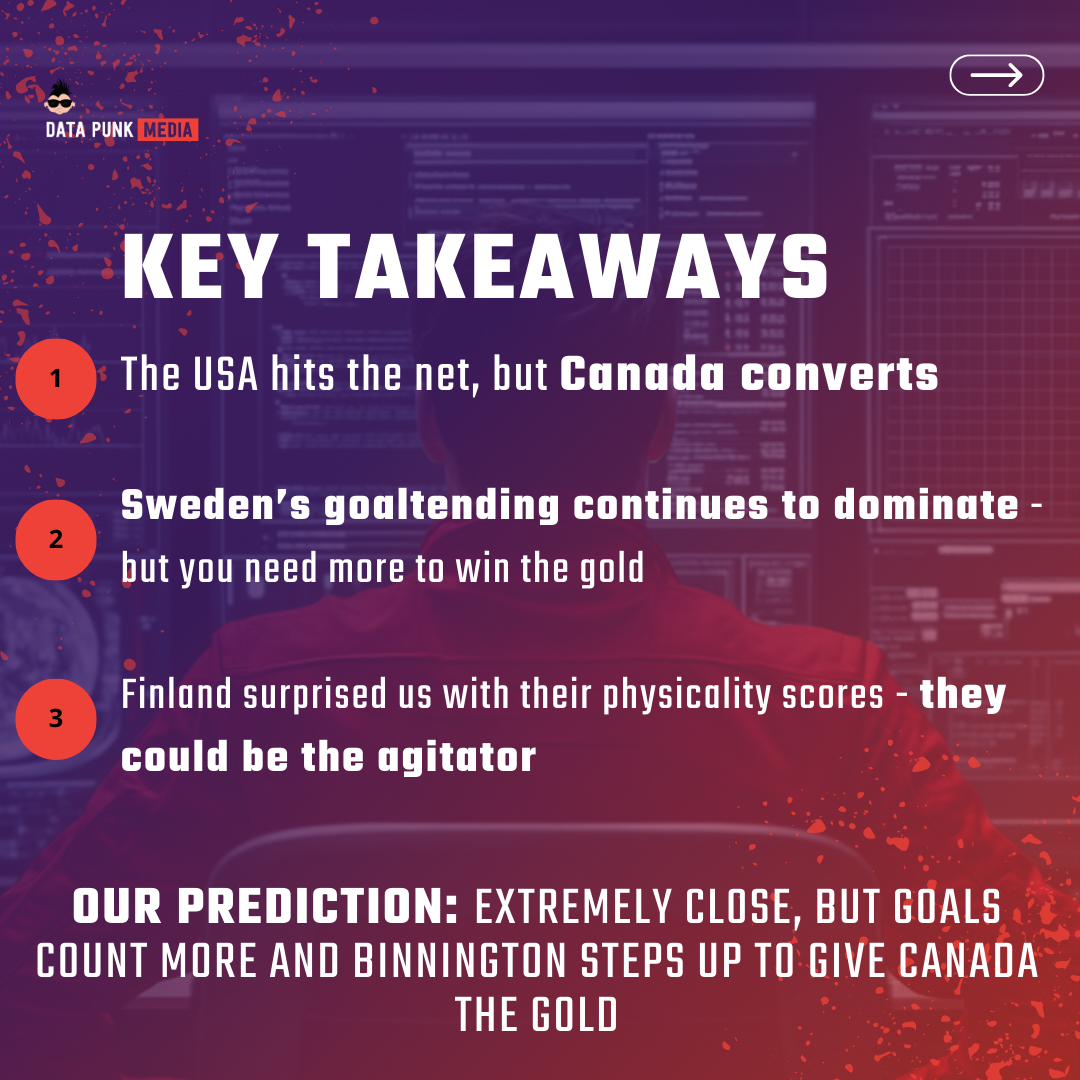

But, this is not really a story; it's a summary.
If we were to write a story today, it'd be focused more on the things that broke a prediction rather than the data that substantiated a claim. That is, we'd do a feature on Connor Hellebuyck and focus on a) the pivotal moments where he stopped Canada that led to Team USA winning the Gold Medal and b) those pivotal moments as missed opportunities that could've changed the outcome of the game.
And the stat? We'd use the fact that Canada had a 1.5 SOG Ratio to Team USA, but they couldn't break through.

That's it. Simple, illustrative and representative of conflict between a team and their opposing goalie.
Do you want to up-level your sports storytelling by integrating stats and AI into them? Then join Data Punk Media today!
In Closing
We here at Data Punk Media are an international team (Canada and USA), so the game was heartbreaking to watch. It was some of the best hockey players in the world representing their countries playing for the gold medal. And the speed with which the overtime period concluded, thus the gold medal game won (and lost) must have been shocking to both teams.
But, if you step away from who won or lost a medal, it was some of the best hockey we've seen in a while. The puck moved up and back with lightening speed and precision; penalties made us nervous; cross-ice passing and breakouts were tape-to-tape; and goaltending was outstanding. And for those of you who have played organized hockey, you've likely experienced this type of defeat – quick and swift in the face of an unsurmountable pressure on which you just couldn't convert.
Sure. If the puck had bounced differently a couple of times, Team Canada would be the ones with the gold medals right now. But at this point, Hellebuyck deserves a ton of credit and Team Canada needs to regroup.
Next up in our Sports, AI and Storytelling course? The first leg of the 2026 F1 season and taking our F1 Drive Score for a test drive.
Be sure to check out the full living course module on the Men's Olympics here.