
A Beginner's Guide for Turning Content into a Business
Introduction
When we first started out, we weren't thinking about what we did as 'a business.' We enjoyed sports – out of the gate it was hockey – and began to just write about what we enjoyed. It was a passion project. The more we wrote, however, the more our passion deepened and the more we wanted to expand our operations.
But, we hit a wall. (Truth is, we hit several walls.)
There are so many options when you're contemplating a business that involves content. And you really have to look inward to understand how your passion addresses a customer problem and then how you can build a business model around it. For example:
Do you want to be a consultant and your content shows your expertise?
Do you want to be a teacher and build online courseware?
Do you have deep and insightful views of the world of politics you want to write about in a weekly newsletter?
The list goes on. And each inward probe and answer brings with it a slightly different model to implement your content business.
There are, however, some common pitfalls that most of you will encounter. So, we wanted to share five key challenges we had to overcome.
Challenge 1: Have a Business Strategy
You may find yourself experimenting in the beginning; for example, focusing on different subjects, trying out different modalities and platforms, and generally trying to find your bearings. If you give yourself the space to research, explore and experiment with your creativity, you'll shape a better, more durable strategy.
In my thirty years of business, the core of a business strategy has remained about the what, why and how. And you get to these by answering the following questions:
- What is the problem?
- Who is it impacting?
- What is the opportunity?
- What is the solution?
- How do we get after it?
These feel like basic questions; however, they take a lot of time, research and exploration to get to the answers.
That said, the single-most important item on this list is to identify the problem. If you truly understand what your community needs, then you'll be able to start addressing it with your expertise and passion. If you don't, then you're creating you're potentially creating a product or content in a vacuum. And if you're okay writing as a passion, then go for it. But, if you're looking to get serious, to grow, you have to get out there and do research, talk with people, ask questions, watch for signal, etc.
Challenge 2: Create a Business Model
With your strategy in hand, you can now think about creative ways to build out a business. Again, we'd encourage research and experimentation here. Try different things out; talk to your community; build your community of experts and advocates; and get your hands dirty.
Ultimately, though, you need to create a business model. The business model defines how you're going to turn your product, service or content into profit.
Let's explore three different business models.
Consulting
The end goal of consulting is to bill hours to customers. This assumes an area of expertise, for which you charge a nominal rate. This rate could be, for example, a fixed fee engagement (e.g., 5K for a 1 Week Strategy Engagement) or variable rate engagement (e.g., custom project quote for a 3 month contract with support staff). So, your strategy will likely have you niching down in a specific area, designing an offering to cater to a specific type of individual or company, and you'll market that offer through various outbound marketing and content.
In a consulting business model, content would likely be used to showcase your expertise, opinions in a particular area, to market your business, showcase projects, etc.
Digital Products
The end goal of selling digital products is, well, to sell the digital products. And with platforms like Gumroad and Shopify, it is very easy for small companies to get themselves set up with an e-commerce backbone. Your goal is to find and grow a community around a particular area of need and build digital products that progressively advance that community. The products could be newsletters, courseware, e-books, virtual conferences, and so on. And regardless of the product, you'll also need to think through how you build either a paid or organic marketing and sales effort around those products.
In a digital products business model, the content could be the product (e.g., newsletter), so content becomes the core product and the manner in which you would promote the content (e.g., social posts). Thus, you have to think more about complementary content types and reusability from core newsletter to promotional content.
Software
The final example is software. Most software these days is Software as a Service (SAAS), which is Cloud-based software sold via subscriptions (or desktop software managed and delivered via subscription). AI is a good domain example of SAAS software with the plethora of tools and platforms that have been popping up to help creators of all sorts (e.g., Artlist, Midjourney, Runway, etc.). Building software is by far the most complex out of the three examples and can also be very expensive.
The 'scope' part of the business model is very important. If you're a solopreneur, then at some point you'll need to focus to begin manifesting your business model. Having too many projects on the go or spreading yourself too thin is the harbinger of doom for a business – especially in the early days. You of course need to try things out, but finding quick and dirty ways to build and trial MVPs (minimal viable products) is key to getting to a scope that gives you focus.
Also, trying to get scoped is not just about the product itself; it's about all of the support operations around landing that product that we don't know about, forget about or just don't like doing. In short, work towards a tight business model that maps back to your strategy, but build experimentation into the model and make sure you've got bandwidth for the support activities – e.g., marketing, sales, etc.
In a software business model, content would likely be used to market the product, demonstrate how to use it, support the user community on issues/fixes, and so on.
Challenge #3: Create a Content Strategy
A content strategy is a plan that a business uses to create, distribute, and manage content towards a specific goal. A content strategy addresses the following questions:
- Who is the audience?
- What is the intended outcome or goal of the content?
- How will the content engage the audience towards that outcome?
- How will the content help satisfy our business goals?
Also, you may find that you have different types of content, each with its own strategic goal. For example, let's take the solopreneur who wants to create a weekly newsletter. Their content strategy might divide into the following ways:
- Free newsletter content that is used for marketing (e.g., organic growth) to help grow the community. It is public, and the goal is community growth and subscriptions.
- Members-only newsletter content that is sent out to the members of a community. It is membership only, and the goal is to address specific needs and community retention.
- Premium content that is for paid subscribers. This could be behind-the-scenes content, project templates and resources, etc. It is only for paid members, and the goal is to add value and monetize.
The above is a simple stratification, but you begin to see that just with newsletter content, you'll likely have different types of content with slightly different goals and ways to engage your audience. Further, you may cross-leverage the above content for marketing campaigns (e.g., email campaigns to your community, drip-feed courses to new subscribers, etc.).
Challenge #4: Implement an Automated System
The more you build, create and explore, the more you will see a system begin to emerge for you. For example, we developed a Storytelling Framework (see below) that helped us systematize our projects. Using this framework, we have a standard set of tools that we use; we can automate certain parts of the process to save time and reduce errors; we can train people to take on specific parts of this process (and get really good at it); and we can build an assembly line for our projects.
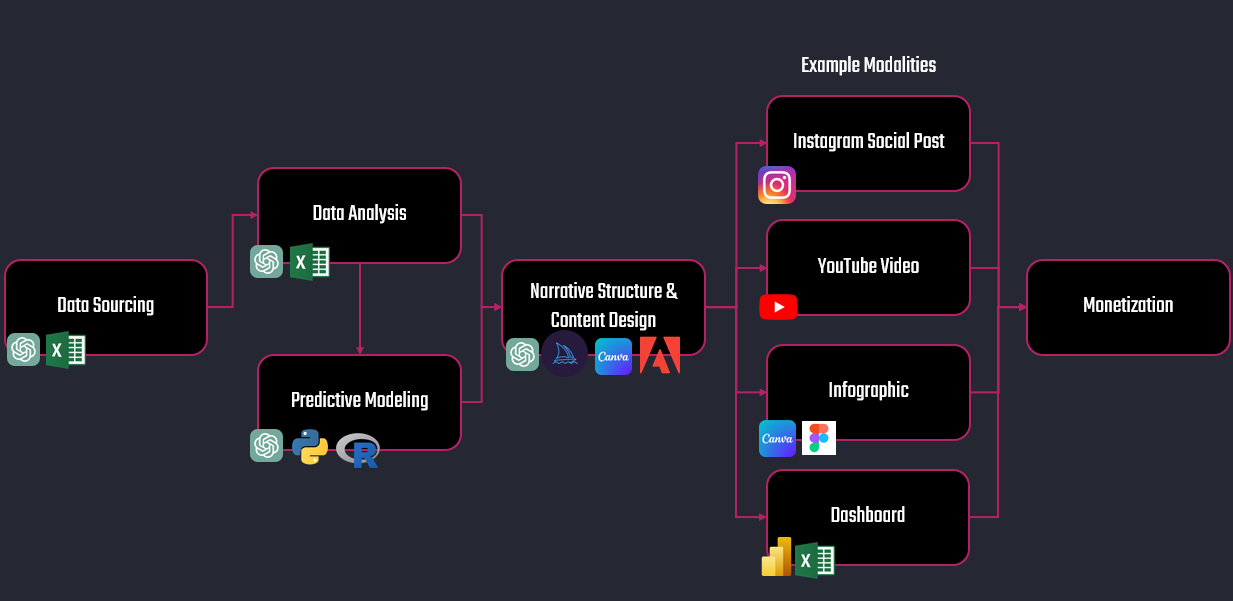
The more we do, the more we document and try and automate. Automation might mean Web scraping with automated data cleaning and transformation, design templates in Canva and Adobe, and SEO templates where we're publishing. But the goal is to incrementally improve the system over time to give you more time on your core offering(s).
If you scope your business model and content strategy, then you can also build a system that can scale. Further, you can also begin to standardize your software tools and get a handle on your operational costs. We ran higher on our operational costs early on and then began to settle as we found specific software that worked for us.
Challenge #5: Measure and React
With the other four elements up and running, it's time to make sure you're measuring your progress. And while it may be difficult to track and measure low numbers in the beginning, it's a must. We measure progress across several areas, as shown below.
- Business Strategy: We have metrics that map into our strategic goals (e.g., subscribers, followers, conversion, etc.). We set goals for each quarter and then track progress each week with a standard report. If we're running ahead or behind in one of our core metrics, then we examine why and either do more of something or change what we're doing to help drive the numbers back to where we need them.
- Operations: We review operating costs against our strategic goals. This includes people, software, marketing, vendors, etc. Early in your business, costs will likely outweigh revenue; plan for this and give yourself a good runway to learn about your business and what works. As long as you're experimenting, learning and getting tighter on scope and focus during this phase, you should find that over time revenue will outpace operating costs.
- Audience Feedback: The signal from your customer is critical. Be sure to use surveys, audit comments, etc. to get at what it is that your audience wants and how they feel about what you're doing. This gets back to addressing the needs (i.e., the problem space) of your customers. If you're not measuring and listening, you're creating in a vacuum.
- Content Metrics: If your core product is content, then this is super critical. For us, content is core to what we do. Here, we measure impressions, unique visitors, origin of visitors, open rates, subscribe rates, clickthrough, and conversion. Note that measuring conversion on your calls to action is where content metrics meet your business strategy.
- Advertising & Marketing: When first starting out, you'll likely try and maximize your organic search and marketing. However, you're going to hit a point where you start investing in advertising. You will find the path that is best for you, but whatever you choose be sure to measure the cost for conversion, leads, subscribers, etc. (That is, whatever your advertising and marketing is trying to drive.)
- A/B Tests: Out of the gate, this may be a tough one. But when you get a good amount of content under your belt and you have established an audience, it's time to start A/B testing. This can be simple, such as testing the effectiveness of two ads within a single advertising campaign, or it can be creating two versions of a YouTube thumbnail to test which one attracts more people.
If you're not measuring anything now, then we'd recommend looking at the above and thinking about how you create a data-driven business to help you find areas of strength (where you can double down) and weakness (where you can decide to set aside or course correct). Either way, it's difficult to react well if you're not measuring well.
Lastly, how do you bring all of the above together so you can track and react?
We typically do this through the following motions.
- Weekly Reports: A weekly recap of accomplishments, what went well, what didn't go so well, and what's up ahead. This is a running view of our progress against our business strategy and metrics.
- Retrospectives: At regular intervals (4-6 weeks), we do a retrospective to explore what we're doing well, not well, where we can improve, etc. (Miro has great templates for you to use for your team.) We'll look at metrics, learning, softer takeaways from our content efforts, etc. in these retros.
- Quarterly Reviews: This is a step back from the work to examine how we're progressing against our strategy. Are we advancing our subscriber base? Is our content driving engagement? Are our stories interesting – and if not, why? We discuss anything that would drive or hold back the strategic numbers (and define course corrections based on what we're seeing).
- Annual Planning: This is where we take the full year in review and talk through how we progress to the next year. We'll do brainstorming as a team here and take input into the next year's 12-month plan.
Learn to Love the Process
When you explore all of the above, you soon realize that while you may think you're operating a simple newsletter, there is actually a lot going on around it. And depending on what you're trying to do, you may need to do more. However, once you learn how to create the infrastructure (i.e., the business strategy, business model, content strategy, operations, and measurement) around your efforts and see that what you do habitually and consistently actually can move the need within that infrastructure, you'll begin to really enjoy it.
Our biggest lesson: everybody moves at their own pace. So, keep niching down to your area of interest but reserve space and energy for the infrastructure around it. You can progressively build it out over time, but starting small early on will give you an advantage to scale and grow as you get better and more experienced.