
Post # 1 in our Within the Numbers series.
Well, Are They?
It sounds like a simple question. In fact, it sounds almost ridiculous. Of course the best teams are the best teams. The standings tell us that. The points don’t lie. Wins are wins.
But while they may not lie, what if the standings hide important details about these top teams? Details that are worth knowing as we approach the playoff season. For example, we create a daily view of how a team performs across key dimensions of their game – i.e., Offense, Defense, Goaltending and Physicality. We average it out as Balance (or what we call the Team Balance Index). The below shows a recent snapshot of the top teams in the NHL standings and where they are stronger and weaker.
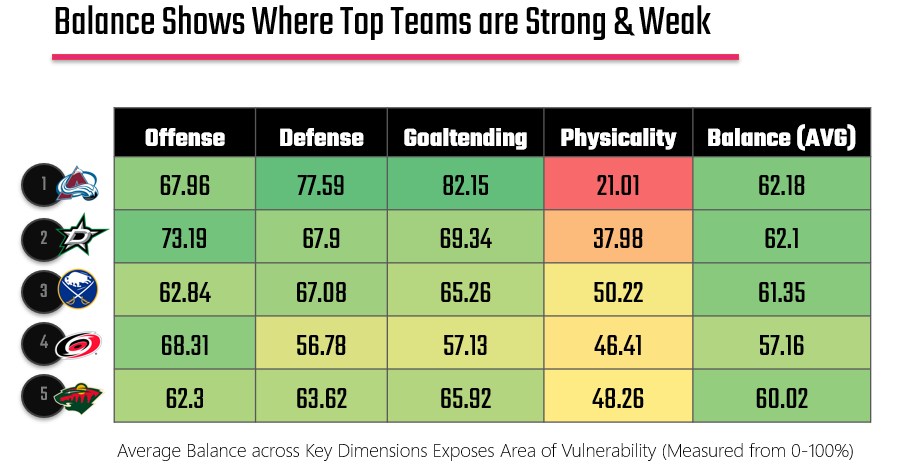
Now, this is a snapshot – so it shifts slightly each day. When thinking forward towards the playoffs, though, it's helpful to see how these top teams have trended across the season.
But, let's do this with a specific metric: Win Expectation.
Want to check out more Sports, AI and Storytelling content? Check out our Stories page.
What is Win Expectation?
Win Expectation uses goal statistics to calculate the likelihood that a team will win. It's a general calculation with a sport-specific exponent, but you can use it in some predictive scenarios and as a comparative between opposing teams – e.g., Colorado Avalanche (74.3%) versus Utah Mammoth (54.8%).
Originally developed by Bill James for baseball, the concept translates to hockey by focusing on two production signals – Goals For and Goals Against. From those, we can estimate how often a team should win based on how that team actually plays.
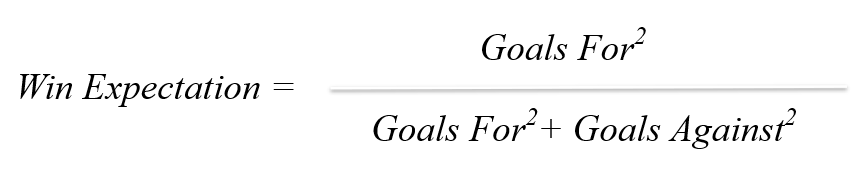
So, Win Expectation points us toward what should happen by virtue of past production (for and against). It is a decent predictor, but note that having a dimensional surround (e.g., like the Team Balance Index details) to see where a team may be running hot or cold is complementary to Win Expectation.
Check out the Sports, AI and Storytelling living course for more how-to content.
Who's on the Rise?
Before we answer that, we like having three views when analyzing sports data:
- A current snapshot, which represents today's reality;
- A trend report, which represents how a team or player got to today's reality; and
- A forecast (or linear regression) to show where might happen in the future.
So, while the earlier Balance details view gives you the current snapshot (and gives you some context as to the strengths and weaknesses of a team), a trend for Win Expectation (across the entire season to date) gives you time-based performance using Win Expectation. As you can see, the results are profoundly interesting with a touch of bad news for Colorado.
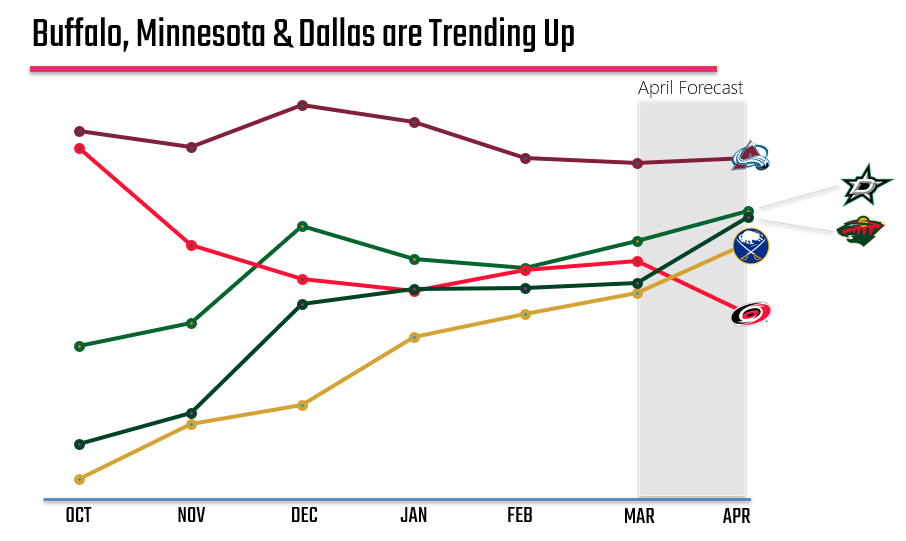
Our analysis of the above?
- Colorado have been consistently strong this season, but in a playoff run they're going to be challenged physically. And in the playoffs, this is one of the biggest challenges to overcome.
- Buffalo are coming straight out of the basement and are making a serious run for the Cup. For Sabres fans, this is decades in the making. With a Balance score that is 0.83 behind Colorado and a more gritty play that is emerging, they are a team to watch.
- Minnesota are also a team to watch, following a similar trajectory to Buffalo and the acquisition of Quinn Hughes, they are showing signs of a true Cup contender.
- Carolina started the season strong, but are on what appears to be a weird recovery curve in this view. Ironically, they are currently in third place in the league as of this writing so perhaps this is a forecast math problem rather than a team performance problem.
- And Dallas started middle of the pack at the beginning of the season and are pushing hard and up for a playoff run.
Unfortunately, only one of Colorado, Minnesota and Dallas can emerge from the Central division. This will be a tough divisional playoff.
Follow our Instagram site where we publish regular content on all things Sports, AI and Storytelling.
So, What's the Takeaway?
It’s not just about being the the top team; it’s about becoming the best when it matters most.
That’s the difference.
Colorado may still be the strongest team on paper, but the playoffs don’t care about what’s on paper. And Buffalo, Carolina, Minnesota and Dallas are close on their heels – closing the gap and surpassing all expectations at exactly the right moment.
