
Within the Numbers Series # 2
The PWHL Didn’t Create Demand. It Revealed It.
When the Professional Women's Hockey League (PWHL) launched in 2024, the response was immediate and overwhelming. Games sold out, attendance records were made, and the league quickly became one of the most talked-about developments in hockey.
In just the first two years of the league, there's been a 30% growth of in-person attendance across the teams that make up the league. And in the latest season, the league has now expanded from the original six teams to now having eight teams.
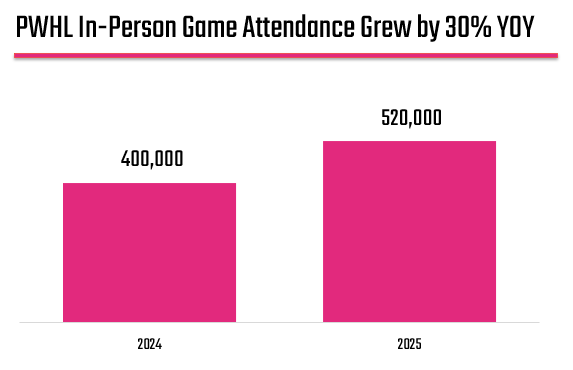
However, when you step back and look at the data, a different story begins to emerge; one that didn’t begin in 2024. What we’re seeing now is not the start of growth in women’s hockey; it’s the emergence of years of seemingly hidden growth into a first-class professional hockey league.
Check out our Instagram site for more PWHL coverage in the weekly series entitled Within the Numbers.
Feeling lazy and don't want to read? Check out our quick-hit video below.
A Decade of Quiet, Consistent Growth
To understand what’s happening today, we need to go back more than a decade.
The first visualization in this analysis tracks women’s hockey participation in North America, using registration data from USA Hockey and Hockey Canada between 2012 and 2025.
At a glance, the chart doesn’t show volatility or sudden spikes. Instead, it shows something more important: consistency and steady growth.
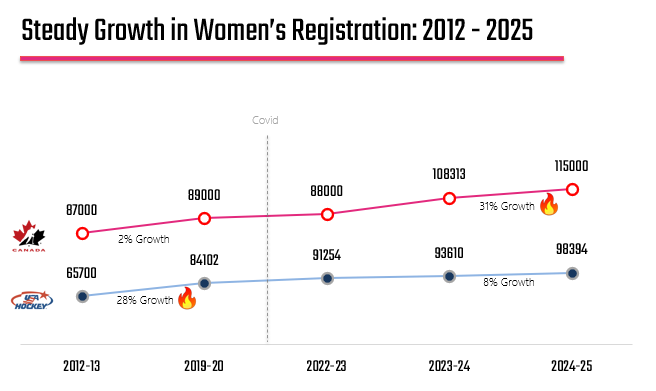
In the United States, participation grew from roughly 65,700 players in 2012–13 to over 98,000 in 2024–25. Canada, already operating from a higher base, remained steady before accelerating to approximately 115,000 players in the most recent season – with a post-Covid growth spike of 31%.
Interestingly, this is not the profile of a trend reacting to a single event. It’s the profile of a system expanding over time. According the Hockey News:
As participation continues to rise across North America—driven by structured development in the U.S. and Canada—the impact is no longer regional. These systems are now exporting talent, raising global standards, and accelerating the growth of women’s hockey worldwide.
For analysts, this distinction matters. Short-term spikes can be driven by external factors, such as media attention, a major tournament, or even a single star player. But sustained, multi-year growth suggests something structural: increased access, improved development pathways, and rising interest at the grassroots level.
The above line chart reinforces this idea. The slope is gradual, but persistent. And that persistence is what ultimately sets the stage for everything that follows.
The Pipeline Effect: Growth at the Entry Level
While total participation and North American development programs are important, it doesn’t tell the full story. To understand where the sport is heading, we need to look at who is entering it (and at what age).
One of the most significant insights from our analysis is the surge in participation among younger players – particularly in the United States. Amazingly, the 6–10 age group has grown by approximately 73%, making it the fastest-growing segment in the system. For example, here's a more detailed view of USA Hockey's registration for women/girls, extracted from the annual reports found here. Towards the right from 2017 onwards and down, you can see the steady growth in the 6 to 10-year old age group.
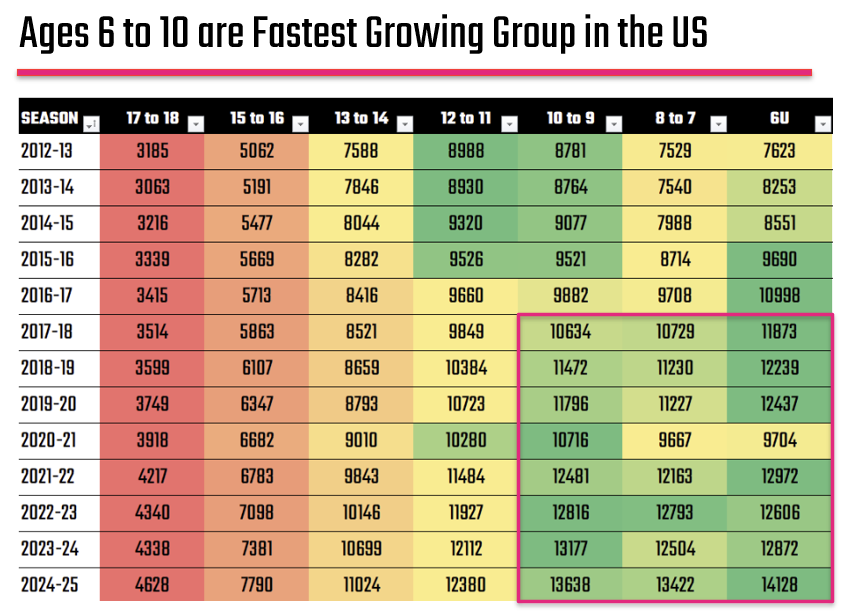
This matters because youth participation functions as a leading indicator and represents the next generation of hockey player coming into the various development programs.
And if growth were concentrated among older players, it might suggest a temporary increase in interest. But when the youngest cohort is expanding the fastest, it signals something more durable: a widening entry point into the sport. In practical terms, this means the future talent pipeline is already being built.
In short, the US development system is not just showing serious signs of growth, but also of scale. Over time, this will compound, resulting in stronger collegiate systems, more competitive national teams, and ultimately a higher-quality professional product.
Want to see more sports stories? Explore the projects and sports stories published on Stories.
Beyond North America: A Global Expansion
But women's hockey goes beyond North America. The below chart compares women’s hockey participation across regions, particularly between North America and Europe. The implication here is that while the United States and Canada remain the dominant contributors, an important shift is emerging: growth is no longer confined to a single geography.
European countries such as Finland, Sweden, Czechia, Switzerland, and Germany have been investing more heavily in women’s hockey infrastructure. This includes development programs, national team support, and domestic league improvements.
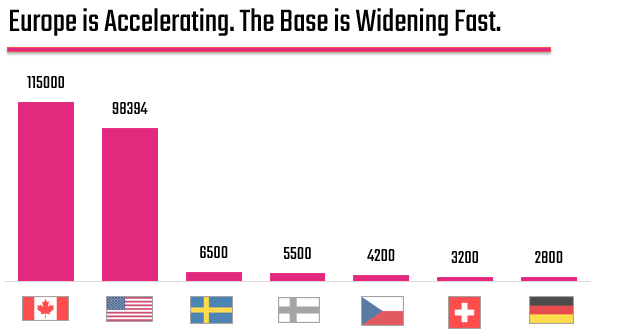
The result is a broader base of participation and a more distributed talent pool. And from a systems perspective, this kind of multi-region growth is critical. It increases the competitive depth of the sport and reduces reliance on any single market. It also introduces variation—different playing styles, training methodologies, and development models—which enrich the overall ecosystem.
The Missing Layer: A Professional Platform
Finally, with the growth in women's and girl's registration – both in North America and globally, the question becomes where does this lead? And what is the stable, visible professional league that sits on top of this growing fo undation?
That’s where the Professional Women's Hockey League comes in.
Launched in 2024, the PWHL represents the first time these underlying trends have been fully connected to a centralized professional structure. With over 60 Olympic players and a unified league model, it provides both legitimacy and visibility in a way previous iterations struggled to achieve.

From a data standpoint, this is the inflection point; the moment where latent demand meets available supply. And by the numbers, there is serious upward momentum for this league to scale.
The Real Story in the Data
When you connect all of these elements – the participation growth, the youth pipeline, the global expansion, and the immediate success of the PWHL – a clear narrative emerges.
Women’s hockey was not waiting to be discovered; it was waiting for the right structure to unlock its potential. The PWHL is the point where that growth became visible to a broader audience and is now poised for significant scale.
And if the current trends continue, the trajectory for women’s hockey points upward, way upward.