
Within the Numbers Series # 12
Drive Score Version 7.0
Heading into Austria, Drive Score 7.0 represented another refinement of the model as we continued placing greater emphasis on recent form. Similar to Version 6.0, the model focused on the five most recent race weekends while incorporating a smaller historical component from previous Austrian Grand Prix performances.
With the season progressing, the Chinese Grand Prix joined Australia in being removed from the weighting structure. As the opening two races of the year, both had become less representative of the current competitive order, allowing the model to place greater emphasis on the most recent performances heading into Austria. The weighting structure and resulting driver projections can be seen below.
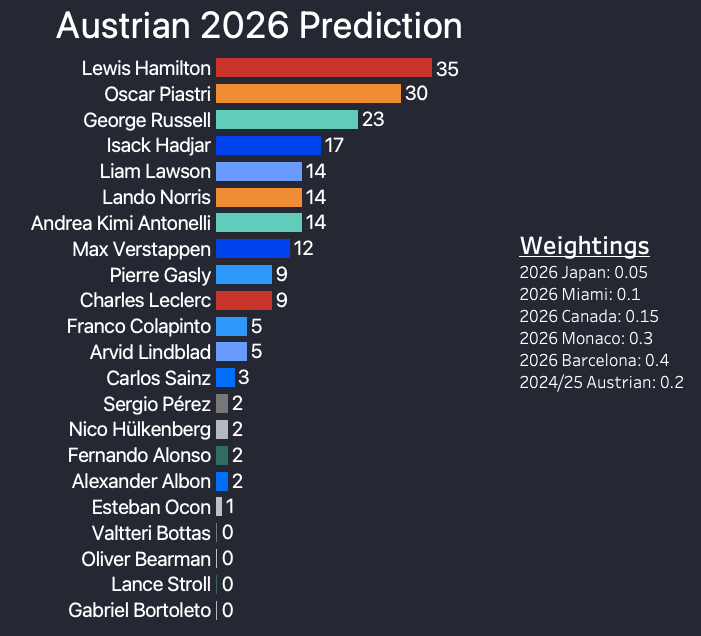
One of the biggest storylines entering the weekend was Kimi Antonelli's projection. Despite leading the Drivers' Championship by 41 points heading into the Austrian Grand Prix, the Mercedes driver ranked lower than expected in Drive Score 7.0. Spain's retirement carried the greatest influence in the model, while Austria's historical component also worked against Antonelli after a DNF in 2025 and no Formula 1 experience at the circuit in 2024. Together, those factors created what we believed was a clear outlier in the model.
Instead, Lewis Hamilton emerged as Drive Score 7.0's favorite, with Oscar Piastri and George Russell close behind. Austria would ultimately test whether the model had correctly detected the first signs of vulnerability in Antonelli's dominance, or whether his lower projection was simply the product of an unfortunate combination of circumstances.
Interested in taking one of our live workshops on Sports, AI and Storytelling? Then check out our Offerings page.
What Went Down in Austria?
Qualifying delivered one of the more dramatic sessions of the season, with George Russell holding onto pole position after a controversial Q3. Ferrari continued to show that it is closing the gap with Mercedes, locking out the second row with Charles Leclerc and Lewis Hamilton. And despite being identified as the model's biggest outlier heading into the weekend, Andrea Kimi Antonelli qualified fourth, while Max Verstappen, Lando Norris, Oscar Piastri, and Isack Hadjar rounded out a top eight once again dominated by Formula 1's four leading teams.
The top eight qualifiers were:
- George Russell (Mercedes)
- Charles Leclerc (Ferrari)
- Lewis Hamilton (Ferrari)
- Andrea Kimi Antonelli (Mercedes)
- Max Verstappen (Red Bull)
- Lando Norris (McLaren)
- Oscar Piastri (McLaren)
- Isack Hadjar (Red Bull)
The Grand Prix itself developed into one of the strongest races of the season, with Mercedes, Ferrari, Red Bull, and McLaren all appearing remarkably close on outright pace at the start of the race. Russell made a clean getaway from pole and controlled the race throughout, maintaining a comfortable advantage despite the pit-stop cycle briefly shuffling the order. He ultimately claimed victory in 1:26:37.979, while Verstappen produced his strongest drive of the season to finish just +1.611s behind. Antonelli completed the podium another +0.375s after Verstappen, meaning the top three were separated by less than three seconds at the checkered flag. Behind them, however, the gap widened significantly, with Oscar Piastri finishing over 21 seconds adrift in fourth.
The top eight finishers were:
- George Russell (Mercedes) – 1:26:37.979
- Max Verstappen (Red Bull) – +1.611s
- Andrea Kimi Antonelli (Mercedes) – +1.986s
- Oscar Piastri (McLaren) – +21.809s
- Lewis Hamilton (Ferrari) – +26.393s
- Isack Hadjar (Red Bull) – +29.399s
- Lando Norris (McLaren) – +31.505s
- Charles Leclerc (Ferrari) – +45.659s
Austria also highlighted just how quickly race circumstances can differ from qualifying. Ferrari looked poised for a strong result after locking out second and third on the grid, but tyre degradation and race strategy prevented both drivers from converting that pace into podium finishes, with Hamilton dropping to fifth and Leclerc falling to eighth after starting on the front row.
From a Drive Score perspective, Austria produced a mix of encouraging signals and important misses. Russell's projection proved accurate as he converted another strong model ranking into victory, while Piastri finished just below where the model expected. The weighting system clearly underestimated both Verstappen and Antonelli whose recent results suppressed their scores despite both demonstrating race-winning pace. However, while Antonelli comfortably outperformed his projection, he still finished behind teammate George Russell, who secured pole position and controlled the race from start to finish.
It raises an interesting question heading into the second half of the season: was Austria simply an outlier in the model, or an early indication that the balance within Mercedes may be beginning to shift? With Russell winning, Verstappen finishing within two seconds, and Antonelli only fractions behind, the battle at the front appears closer than it has at any point this season. If that trend continues, Drive Score may soon need to account for a championship fight that is becoming increasingly difficult to separate.
Check out our Instagram site for more sports stories and F1 coverage.
Drive Score Version 8.0
Heading into the British Grand Prix, Drive Score Version 8.0 represents the latest evolution of the model as we continue refining which factors best capture driver performance over the course of a Formula 1 season.
One of the biggest additions in Version 8.0 is a new 20% season-average component. While 60% of the model will continue to come from the five most recent Grand Prix races using tapered weighting, and 20% will continue to come from historical Drive Scores at Silverstone, the remaining 20% will now reflect each driver's average Drive Score across the 2026 season.
This change comes directly after Austria, where Andrea Kimi Antonelli's retirement in Spain heavily impacted his Drive Score 7.0 prediction. Because the Spanish Grand Prix carried the highest weighting in the model, his DNF significantly lowered his projected score despite leading the Drivers' Championship and consistently performing at the front throughout the season. By incorporating a season-average component, Drive Score 8.0 should be less sensitive to individual outlier results while still placing the greatest emphasis on recent form.
The complete weighting structure and Drive Score Version 8.0 projections for the British Grand Prix can be seen below.
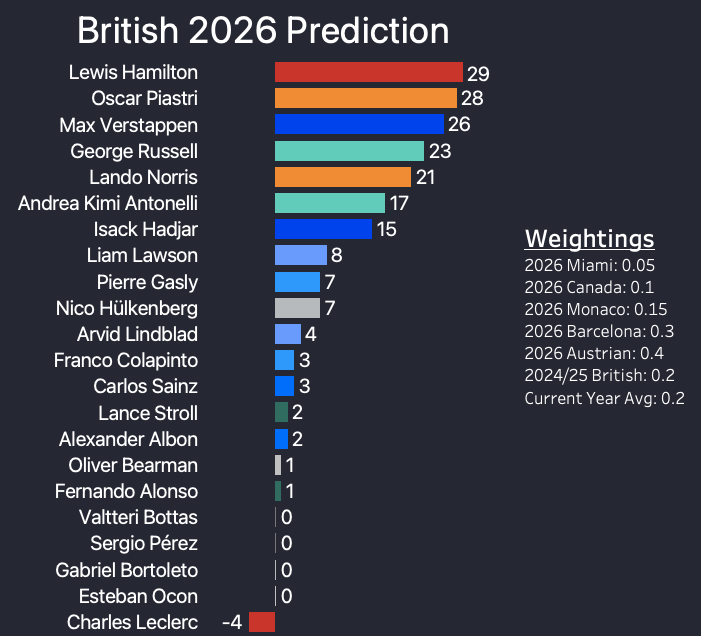
The addition of the season-average component also appears to bring the field closer together, which better reflects what we have seen on track in recent weeks. As Mercedes, Ferrari, McLaren, and Red Bull continue to tighten the gap in both qualifying and race pace, the model now shows a more compressed group of contenders rather than one or two drivers separating too far from the rest of the field.
The most abnormal result is Charles Leclerc, who sits at -4 in Drive Score 8.0. While that number stands out immediately, it is largely explained by a difficult combination of recent race results and poor historical performance at Silverstone. Leclerc finished 14th at the British Grand Prix in each of the past two seasons, and even with the new season-average component helping to stabilize the model, those factors were enough to pull his projection well below the rest of the grid.
Want to see more sports stories? Explore the projects and sports stories published on Stories.
Looking Ahead to Great Britain
The British Grand Prix will provide the first opportunity to evaluate whether the addition of the season-average component improves the model's ability to identify the true competitive order of the field. By balancing recent form with a driver's overall performance across the season, Drive Score 8.0 aims to reduce the impact of isolated outlier results while remaining responsive to changes in momentum.
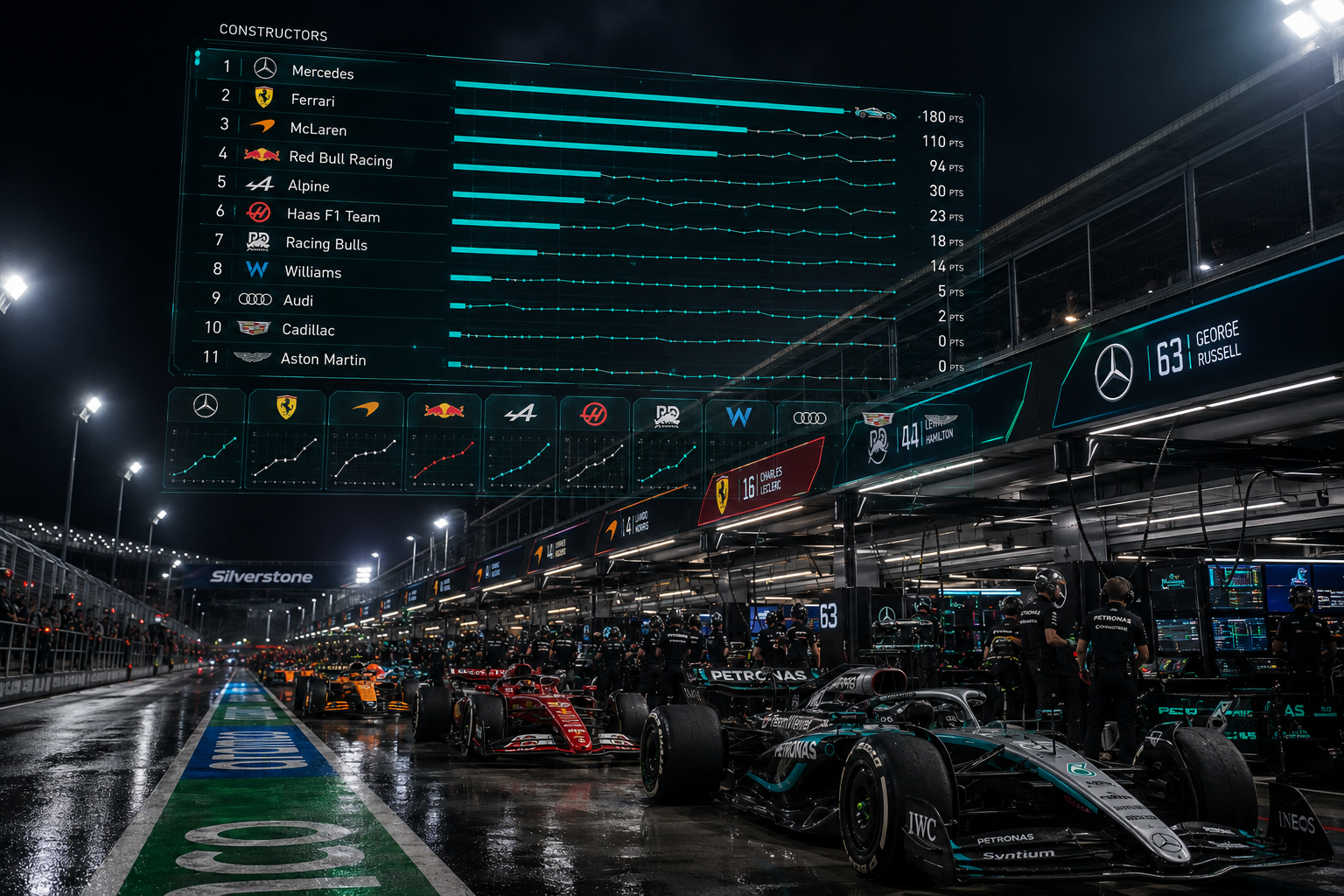
The spotlight once again falls on Andrea Kimi Antonelli. Despite leading the Drivers' Championship, the Mercedes driver enters the weekend ranked behind several of his closest rivals, raising the question of whether Drive Score 8.0 reinforces the first signs of vulnerability identified by Version 7.0, or whether Austria simply represented an outlier in an otherwise dominant campaign. With Hamilton, Russell, Verstappen, and the McLarens all showing race-winning pace in recent weeks, Silverstone promises to be another important test for both the championship and the continued evolution of the Drive Score metric.

