
Within the Numbers Series # 13
Drive Score Version 8.0
Following Austria, Drive Score Version 8.0 introduced the model's largest refinement of the season by adding a season-average component alongside the existing historical and recent-race weighting. The goal was simple: continue rewarding current form while preventing a single outlier result from having an outsized impact on future predictions.
The updated model allocated 60% of its weighting to the five most recent Grands Prix using a tapered approach, 20% to each driver's average Drive Score across the 2026 season, and the remaining 20% to historical Drive Scores from the previous two British Grands Prix. The resulting projections are shown below.
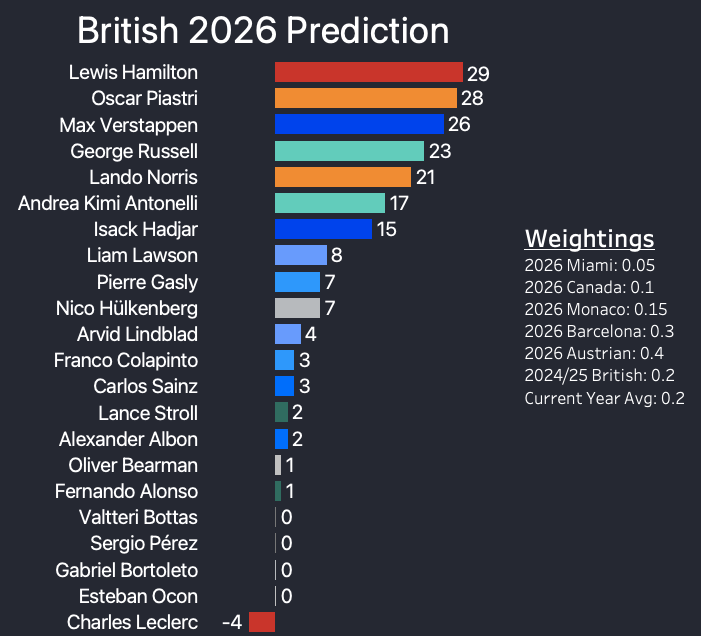
The new season-average component also produced a noticeably tighter field. Rather than one or two drivers separating themselves from the rest of the grid, the projections reflected the increasingly competitive nature of the 2026 season as Mercedes, Ferrari, McLaren, and Red Bull continued to converge in performance.
One of the most notable projections was Charles Leclerc's -4 Drive Score, by far the lowest among the front-running drivers. While the result appeared surprising, it was largely driven by a combination of difficult recent race results and consecutive 14th-place finishes at Silverstone in the previous two seasons. Together, those factors outweighed the stabilizing effect of the new season-average component, leaving Leclerc with the lowest Drive Score on the grid heading into Silverstone. As the weekend unfolded, that projection would quickly become the model's biggest storyline.
Interested in taking one of our live workshops on Sports, AI and Storytelling? Then check out our Offerings page.
How Did Silverstone Unfold?
Sprint Race & Qualifying
Silverstone's Sprint weekend provided an early indication of how Drive Score 8.0 compared to the competitive order before Sunday's Grand Prix. The Sprint race largely aligned with the model, with many of the projected front-runners finishing near the front. Most notably, Charles Leclerc was able to finish fifth, despite entering the weekend with the lowest Drive Score among all drivers.
Qualifying, however, began to tell a different story. Kimi Antonelli claimed pole position, while Ferrari locked out the second row with Charles Leclerc and Lewis Hamilton qualifying second and third, further reinforcing the team's recent pace. George Russell qualified fourth, followed by Isack Hadjar, Lando Norris, Max Verstappen, and Oscar Piastri.
Although Drive Score 8.0 continued to identify most of the weekend's leading contenders, Leclerc's performances in both the Sprint and qualifying suggested he had arrived at Silverstone with considerably more pace than the model had anticipated. Sunday's Grand Prix would ultimately confirm that suspicion.
The Grand Prix
Sunday's Grand Prix immediately answered the central question surrounding Drive Score 8.0. While the model correctly projected Ferrari to be among the fastest teams by ranking Lewis Hamilton first overall, it significantly underestimated Charles Leclerc, who entered the weekend with the lowest Drive Score of any driver on the grid. Both Ferraris overtook polesitter Antonelli into the opening corners, with Leclerc immediately taking control of the race ahead of Hamilton. From that point forward, he rarely looked under serious pressure, confirming what the Sprint race and qualifying had already suggested: Leclerc arrived at Silverstone in far stronger form than the model anticipated.
The race was also shaped by several pivotal moments. Oscar Piastri damaged his front wing on the opening lap, effectively ending his challenge, while Antonelli's race unraveled on Lap 41 after a front-left wheel shield failure severely compromised his Mercedes. Although he attempted to continue, additional pit stops and a late five-second penalty dropped him from a likely podium finish to 16th.
Another dramatic twist came when Max Verstappen spun from third place with just four laps remaining, triggering a Safety Car. Mercedes opted to leave George Russell on used medium tyres while most of the field switched to fresh softs, gambling that the race would not restart. Formula 1's Safety Car regulations ultimately prevented a final green-flag lap, allowing Russell to inherit second while Hamilton completed Ferrari's double podium behind Leclerc's first place finish.
From a Drive Score perspective, Silverstone became the model's toughest test of the season. Leclerc didn't simply outperform his -4 Drive Score, he dominated the weekend by winning from the front and ending a 37-race winless streak. At the same time, Antonelli's mechanical failure, Piastri's opening-lap damage, Verstappen's late retirement, and the Safety Car finish all significantly altered the competitive order. While Drive Score 8.0 once again identified much of the competitive order, Silverstone demonstrated that exceptional individual performances, and the unpredictable nature of Formula 1 itself, can still outweigh even the strongest statistical projections.
Check out our Instagram site for more sports stories and F1 coverage.
Drive Score Version 9.0
While Drive Score 8.0 successfully addressed some of the shortcomings identified after Austria, Charles Leclerc's victory at Silverstone revealed another opportunity for improvement. As a result, Drive Score Version 9.0 introduces another significant refinement aimed at making the model more resilient to the unpredictable nature of Formula 1. Building on the season-average component introduced in Version 8.0, the latest update further reduces the influence of isolated retirements and unusually poor race weekends by placing equal emphasis on recent form, season-long performance, and historical circuit results.
Two key changes have been made ahead of the Belgian Grand Prix. First, the weighting structure has been adjusted so that recent momentum, season-long performance, and historical circuit performance each account for one-third (33.3%) of the final Drive Score. Previous versions placed greater emphasis on recent results, but the past several races demonstrated that isolated incidents could disproportionately influence the final rankings.
The second change is the replacement of the current season average with the current season median. Unlike an average, which can be heavily influenced by mechanical retirements, penalties, or crashes, the median better represents a driver's typical level of performance by minimizing the effect of outlier results.
This refinement was largely motivated by the contrasting cases of Kimi Antonelli and Charles Leclerc. Antonelli's retirement in Spain significantly hurt his Drive Score 7.0 projection for Austria despite consistently running near the front throughout the season, while Leclerc's difficult recent results and poor historical record at Silverstone contributed to the lowest Drive Score 8.0 on the grid before he went on to win the British Grand Prix. Version 9.0 aims to reduce the influence of those isolated weekends while continuing to reward sustained performance over the course of the season.
The updated weighting structure and resulting driver projections for the Belgian Grand Prix are shown below.
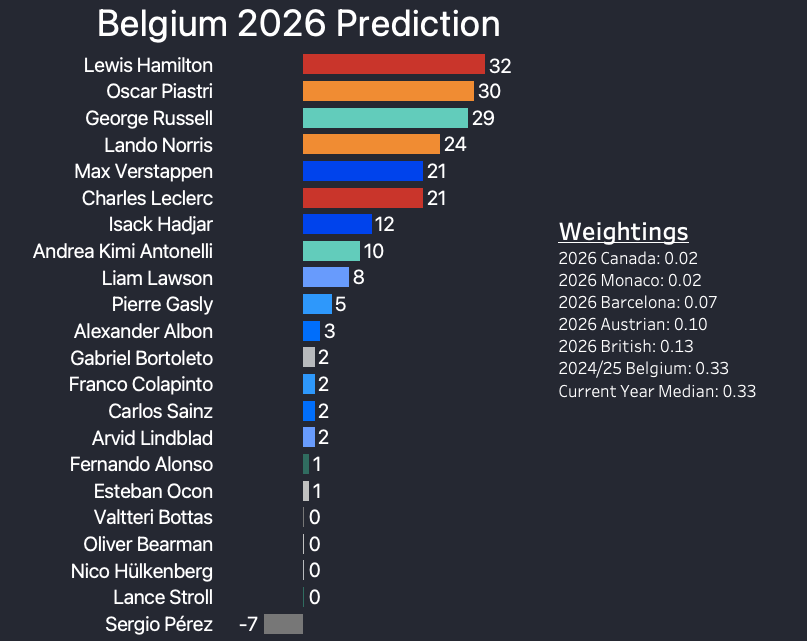
At first glance, the updated projections suggest a much tighter battle at the front of the field. By giving equal weight to recent momentum, season-long consistency, and historical circuit performance, Drive Score 9.0 better reflects how closely matched Formula 1's leading teams have become over the past several race weekends.
The new model projects Lewis Hamilton to enter Belgium with the strongest Drive Score, narrowly ahead of Oscar Piastri and George Russell, with only small margins separating the leading contenders. The shift to a median-based season metric also addresses the two largest outliers from recent versions of the model. Antonelli rebounds from the unusually low projection seen ahead of Austria, as his retirement in Spain no longer disproportionately impacts his season performance, while Leclerc climbs back toward the front of the rankings following his Silverstone victory. Rather than allowing a single exceptional or unfortunate weekend to heavily influence the model, Drive Score 9.0 aims to better capture each driver's typical level of performance heading into the Belgian Grand Prix.
Want to see more sports stories? Explore the projects and sports stories published on Stories.
Looking Ahead to Belgium
The Belgian Grand Prix will provide the first opportunity to evaluate whether Drive Score Version 9.0 has successfully addressed the shortcomings exposed at Silverstone. By balancing recent momentum, season-long consistency, and historical performance equally, the updated model aims to produce a more stable picture of the competitive order without overreacting to individual race weekends.
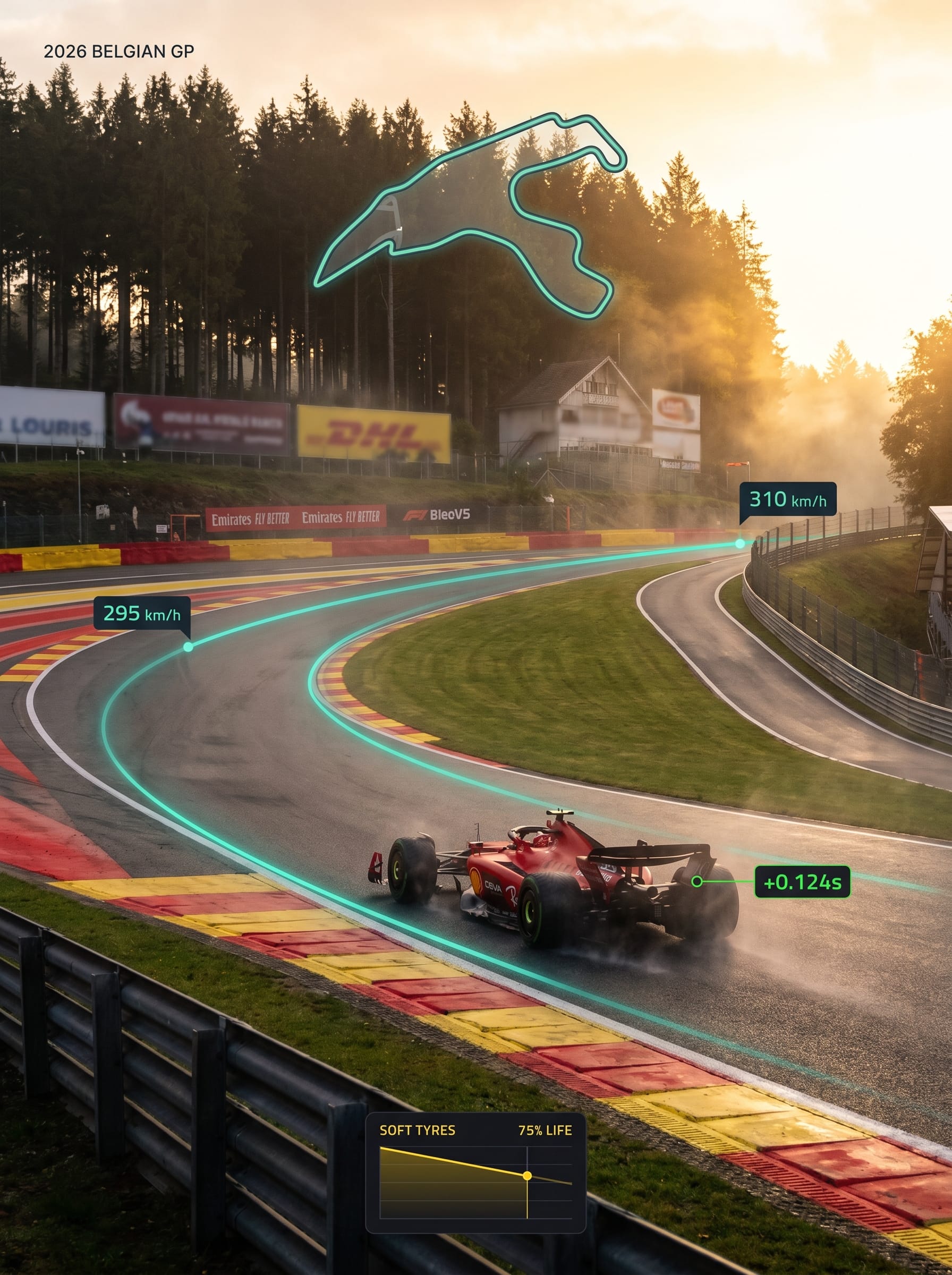
Lewis Hamilton enters Spa-Francorchamps with the highest projected Drive Score, narrowly ahead of Oscar Piastri and George Russell. Meanwhile, Charles Leclerc's Silverstone victory and Kimi Antonelli's recovery from recent outlier results are now more accurately reflected in the model, setting up one of the closest prediction battles of the season.
Belgium will ultimately determine whether Version 9.0 has struck the right balance. After Charles Leclerc exposed the Version 8.0's biggest blind spot at Silverstone, Spa-Francorchamps offers the first chance to see whether those lessons have translated into more accurate predictions.

