
Six key dimensions to move you from content idea to a content business.
Introduction
The creator economy is estimated to grow to an astronomical $530B by 2030, but the dream of owning and operating a content business can seem elusive. How do you get started? How do you go from idea to content to offering? How do you tap into this growing economy? So many questions.
Ugh.
The reality is that many of us share the growth pains in this space, for example, posting consistently, not sure what to measure, growth is flat, revenue is nonexistent, etc. Most importantly, you can't tell if what you're doing is actually making a difference.
The reality is that it can take a looong time to get from idea to operational business. In fact, once you start the journey you realize it never quite ends – it just morphs and evolves as you go (and hopefully along a trajectory of growth). But, rest assured that there is a path through this seemingly inexorable journey; it just isn't taught all in one place.

That said, we've gone through our share of trials and tribulations, so we wanted to package the key things that have helped us build a better strategy for our business and begin to deliver against it. You might have seen some of the You, Inc. coverage around 'building yourself as a product', well in this post we reframe You, Inc. to focus on the content solopreneur as opposed to the athlete.
What is You, Inc.?
At Data Punk Media, we built a framework called You, Inc. originally for athletes, which is the idea that a person, like a product, can be designed, tested, positioned, and grown deliberately instead of left to chance. Athletes have short career windows and seriously brutal market competition, which makes them an interesting test case.
The framework wasn't really about sports. It was about what happens when someone treats themselves as a product with inputs and outputs. We built the framework from our experience in product development, which frankly can be applied to many different scenarios – athlete, content solopreneur, and so on.
Content creators are a very similar test case to athletes, maybe just with a slightly different scoreboard. For example, if you're building a newsletter, a YouTube channel, a podcast, or any kind of independent media business, you are the product. Your byline, voice, judgment, and face on a thumbnail represent the enterprise. There's no HR department managing your burnout, no legal team protecting your brand, no CFO telling you what your subscriber math actually means. You're running all six functions of a business, usually alone, usually while also trying to have a life.
Yeah, it's frickin' exhausting!
Because you are the business, it helps to think about how you can create a repeatable, durable and growth engine that takes your ideas and systematizes them through a business model. Simply pumping content out is likely not going to be your "core" product; it is more likely to be that which engages your audience and drives them to your offering. And nobody really teaches you this rhythm of going from idea to prototype to product to revenue (and then building a system to evolve that product over time).
Six Dimensions
Our original You, Inc. framework (for athletes) has six dimensions: Vision & Identity, Health & Performance, Skills & Craft, Brand & Reputation, Storytelling & Marketing, and Wealth & Finance. These make sense for athletes, especially those who think of themself as the product. For a solopreneur, though, the dimensions are similar but with some refactoring – specifically for a creator trying to build a content business.
Thus, the refactored You, Inc. for those of you trying to create a content business are: Vision, System, Skills, Brand, Storytelling, and Finances. We'll walk through each one of these, but the obvious changes are 1) a simpler conceptual reference for each dimension and 2) System instead of Health & Performance and Finances instead of Wealth & Finance. For these two dimensions, System is what you build to get to a healthy and performant business and Finances is the act of measuring money coming in versus money going out. They make more sense to the content solopreneur.
Case Study: Mara Ellison
To make it concrete, we'll follow an example creator as we explore the different dimensions: Mara Ellison, a 31-year-old former newspaper data journalist who was laid off eight months ago and is now trying to turn one of her key skills — pulling insights out of messy public datasets — into an independent newsletter business.

Mara is a stand-in for a very common starting point: someone with real craft and curiosity, but not a lot of grounding in how to build a business using these assets.
Dimension 1: Vision
Many creators start with a feeling, not a vision. The feeling might sound like "I want to build an audience" or "I want to do this full-time." That's ambition, and ambition is a fine starting point, but it isn't a vision, and it can't help you make decisions. A vision is specific enough that when you're offered different opportunities (or product ideas or topics), it helps you decide which one to take.
For a creator, the vision question breaks into a few parts that mirror what a founder should answer before building a product: What is the specific need in the market you're serving? Who exactly is this for, not "people who like data" but a defined audience with a well-understood problem? What are you building, and by when? And what will you know when you've arrived? If you can't answer these questions, then you likely don't have a content business yet. You have a hobby with an audience.
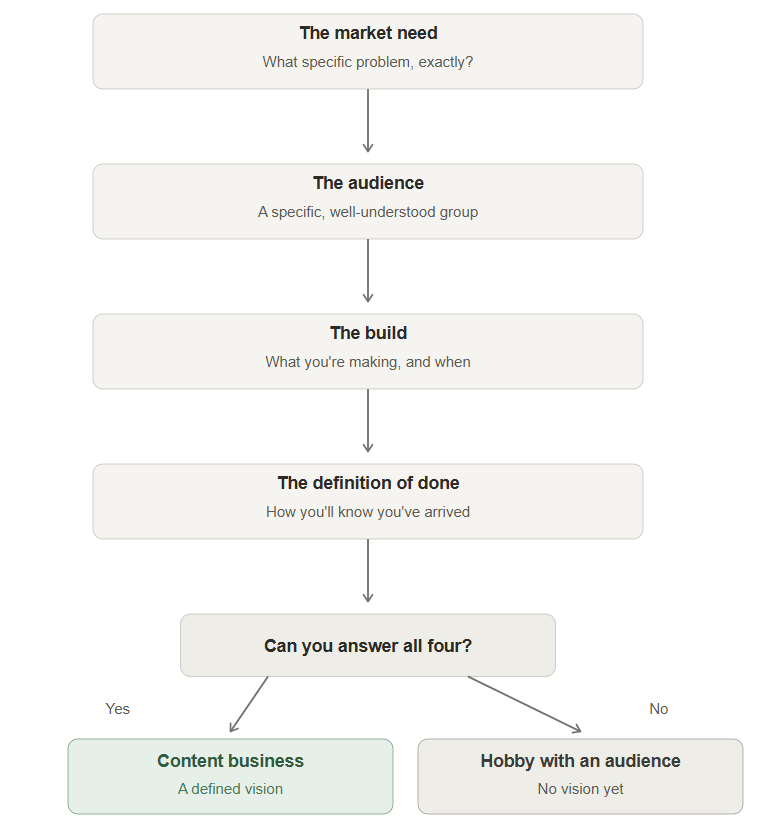
This matters more for creators than it might seem, because the content world rewards breadth in the short term and punishes it in the long term – and you may not feel this until you're burnt out on creating content. Covering everything gets you scattered engagement with little room to grow deep loyalty and following. A vision pushes you to scope your focus and approach. It's the difference between "a newsletter about interesting data" and "a newsletter that uses public records to show renters in mid-size Southern cities exactly how their rent compares to wages, five years running." One of those is a hobby. The other is a potential product that can attract a real audience.
Mara as a Solo Data Journalist
Mara's gap here is a common one. She is an accomplished data journalist, but she hasn't decided who it's for. Her first eight newsletter issues covered a state budget fight, a school district staffing story, a piece on local weather patterns, and an explainer on a corporate tax break. Each one was well-reported, but none of them is really built on the last one. Thus, there is no throughline pulling a reader from issue one to issue eight. Her assignment isn't to work harder. It's to pick a lane specific enough to hurt a little; that is, a defined audience, recurring question she can answer for them, and a one-year target she can measure herself against. This might be a theme, such as local politics, financial news for ruralites, or something else. But, there's glue and a laddering effect (topical or otherwise) that pulls an audience in and keeps them on the journey.
Dimension 2: System
In the original You, Inc. framework, Health & Performance is the physical and mental infrastructure that everything else runs on: no athlete-as-a-product ships without a functioning production line. For a creator, it's not that you shouldn't focus on nutrition, sleep and physical activity – you absolutely should! It's just that building a content business requires more of an operating system behind your output.
That said, the underlying principle here of system is similar: you cannot build a content business on a broken production process or an unmanaged mind, and most creators invest significanctly in the visible output (e.g., the piece, the video, the episode, etc.) but less in the system that produces it consistently.

Two primary elements sit inside this dimension for a creator.
The first is more literal, for example, sleep, stress, and the toll of building something alone, in public, with your name attached to every piece of feedback. Solo creators lose the buffer that employees have; there is no editor absorbing the first draft of criticism and no coworker to vent to between deadlines. The professionals who last are the ones who treat recovery as part of the job, not a reward for finishing it. That means protected off-hours, boundaries around when the metrics get checked, and enough distance from the work to tell the difference between a bad week and a real problem.
The second is more practical: your actual workflow. What's your process from idea to published piece? Where do you source material, how do you draft, edit, design, and schedule, and does that process survive a busy week or fall apart the moment your extended family decides to visit? Creators who publish consistently for years, not months, almost always have a boring, repeatable system underneath the creative work. This looks like, for example, a rhythm for research days, writing days, publishing days, and so on.
What's Mara's System?
Mara's system problem is the one you'd expect from someone six months removed from a newsroom job with an actual production system behind her. She's rebuilding everything from instinct: pulling data late at night after a full day of freelance work, designing charts from scratch in a tool she's still learning, publishing whenever a piece happens to be done. She has no recovery ritual and no repeatable weekly rhythm, which means her best weeks are excellent and her worst weeks produce nothing. Before she touches her vision problem further, she needs a production system — a fixed research day, a fixed writing day, a template for her charts so she isn't reinventing design every issue — because a newsletter that publishes unpredictably can't build the habit loop that turns readers into subscribers.
Dimension 3: Skills
Whatever you build, it has to do what it promises. For a creator, that means the content should be consistently good, which is a lower bar than it sounds and a higher bar than arguably many people hit. This dimension separates two kinds of skill that get treated as one and shouldn't be: threshold skills and differentiating skills.
Threshold skills are what get you taken seriously at all, such as clean writing, basic visual design, a working understanding of your platform's mechanics, and so on. You need these, but being excellent at them doesn't make you distinctive, because everyone else in your niche has them too. Differentiating skills are the ones that make you irreplaceable once someone finds you: a specific analytical lens, a reporting method nobody else in your space uses, a voice that can't be copied. The mistake most creators make is polishing threshold skills indefinitely, for example, tweaking thumbnails, obsessing over subject lines, and so on, while under-investing in the one or two things that would actually make them impossible to substitute.

Deliberate practice is very important. That said, publishing constantly is repetition, not necessarily improvement. The creators who compound their skills are the ones who treat a chunk of their practice as structured and uncomfortable, for example, studying how a specific chart type is built, requesting real feedback on a weak piece instead of just moving to the next one, deliberately trying a format that stretches a skill they haven't mastered, and so on. One way to quietly improve is with each project, add one innovation. It could be a new tool you use, a new way of analyzing data or a resource you want to provide your community.
How Can Mara Differentiate?
Mara's differentiating skill is rare; she can pull a public dataset that most people would find unreadable and turn it into a chart that makes the story obvious – in a very short period of time. That is a real edge. However, her threshold skills are the problem; that is, her prose is dense and paragraph-heavy in a way that reads like a newspaper story, not a newsletter a subscriber opens on their phone between meetings, and her charts, while accurate, are inconsistent in style from issue to issue. She doesn't need to become a different kind of writer. She needs sharper editing habits and one consistent visual template, so the rare skill she already has isn't buried under an accessibility problem.
Dimension 4: Brand
Your brand is what people say about your work when you're not in the room, and as a creator, you no longer have an institution's reputation to borrow. When Mara worked at a newspaper, the masthead did real work for her: it told a reader, before they'd read a word, that the piece was vetted, accurate, and worth their time. As an independent creator, however, that trust has to be rebuilt from scratch, attached to a name nobody knows. This is a serious hill to climb and pretending otherwise sets creators up to be confused about why early growth feels so slow.
The upside is that an independent brand can be more specific and more trusted than an institutional one, precisely because it's a real person with a consistent point of view instead of a rotating byline. The starting point is a one-sentence positioning statement that a stranger could repeat back accurately: who you are, what you do, and who it's for. "A newsletter about local news" describes a category. "The person who turns your city's public budget data into three charts you'll actually understand" describes a product. The second version is rememberable and referable; someone can describe it to a friend without losing the point.
From there, brand is compounding, not viral. It's built through the accumulation of small, observed behaviors: whether you correct your own mistakes publicly, whether your tone stays consistent when a piece underperforms, whether the fifteenth issue is as careful as the first. Your digital presence; that is, the newsletter archive, the about page, the social profiles, and so on, functions as infrastructure here. It's often the first thing a potential subscriber, sponsor, or collaborator checks before deciding whether to trust you with their inbox or their money.

What is Mara's Brand?
Mara currently has almost no independent reputation, which is normal and not a crisis; it's her starting position out of the gate. Her risk is trying to shortcut it by chasing virality on a single big story instead of doing the unglamorous work of being reliably good sixteen weeks in a row. Arguably, her first task when it comes to building a brand is to write her one-sentence positioning statement, put it everywhere, for example, the newsletter header, her bio, her pitch to potential sponsors, and so on. And then let consistency, repetition and reinforcement do the compounding work that a single viral hit never quite does.
Dimension 5: Storytelling
The best content in the world fails without distribution, and this is the dimension where most new creators quietly give up, because they assume good work finds its own audience. It doesn't. Storytelling, for a creator, is the deliberate work of getting a specific message in front of a specific, reachable audience. Storytelling starts with something that looks a lot like market research: where is your specific angle underrepresented, and who is interested in what you're creating? So, meeting an audience where they are.

Two ideas from the You, Inc. framework translate directly. The first is that your network is your distribution channel, and it works through trust, not volume. One other creator recommending your newsletter to their audience, or one journalist citing your analysis, moves more people than a hundred cold posts, because the credibility transfers along with the introduction. The second is timing; showing up consistently and staying visible before you desperately need the opportunity, rather than only reaching out when you're out of runway.
One trap for creators is trying to be everywhere at once: a newsletter, a YouTube channel, a TikTok account, and a podcast, all launched in the same month, none of them built to the point where they actually work. Distribution, like everything else in this framework, rewards concentration over being spread too thin. In this sense, less can be more. Pick the one channel where your audience already spends time and your specific format works, get it functioning well enough to convert visitors into subscribers, and then consider a second channel, ideally one that repurposes what the first channel is already producing rather than starting an entirely separate content operation.
What is Mara's Distribution Problem?
Mara's distribution problem is that she has none, at least in the structural sense; that is, she's been treating her publication as the finish line instead of the starting line. Each issue goes out to a small list of people she already knew from her reporting days, then nothing actively pulls new readers in. She has no real answer to where her ideal reader already spends time looking for exactly this kind of analysis, whether that's local subreddits, other regional newsletters with adjacent but non-competing audiences, or journalists who'd cite her work if they knew it existed. Her most useful move isn't a new platform. It's identifying three specific places her actual audience already congregates and building a deliberate, repeatable way to reach them from each new issue.
Dimension 6: Finances
A product that generates no sustainable return eventually disappears, and this is the dimension creators avoid longest, because it's the least fun and the most exposing. It can be easier to obsess over subject lines than to sit down and calculate exactly how many paying subscribers you'd need to replace a salary, or to admit that eight months into a project, the honest answer is zero. Not fun.

The original framework's "career window problem" translates similarly for creators, just with a different clock. How? Athletes have a finite number of playing years. Creators have a finite runway (e.g., savings, severance, a partner's income, a day job's patience, etc.) and the mistake is similar in both cases: assuming there will always be more time to figure out the business model later. The earlier a creator treats their content as something that has to generate return, the more optionality they preserve. Waiting until the runway is nearly gone to think seriously about monetization is the content-world equivalent of an athlete waiting until retirement to think about a second career.
Diversification matters here too. A single revenue line (such as ad revenue, one platform's creator fund, one big sponsor, etc.) is fragile in exactly the way a single-employer career is fragile. A sturdier model usually integrates several smaller streams, for example: paid subscriptions from a portion of the audience; sponsorships or underwriting from brands who want access to that specific audience; and often a service layer (consulting, freelance work, speaking, or licensing the underlying skill directly) that draws on the same expertise the content demonstrates. And just as with athletes, non-financial capital counts here; that is, the intellectual capital of getting sharper at your specific craft, the social capital of the relationships the content builds, and the reputational capital of being known for something specific. None of that shows up on a bank statement, but all of it compounds and eventually converts.
How is Mara's Financial Situation?
Mara's financial dimension is the most urgent gap in her whole profile, and she knows it, which is actually a good sign; the people who struggle most are the ones who haven't even registered the gap exists. She has zero monetization in place, no paid tier, no sponsor conversations started, and a runway with a visible end date. The honest recommendation isn't to launch a full subscription business overnight. It's to pick one small, immediate revenue test, even a modest paid tier for her most loyal readers, or one sponsor conversation with a local business that would value her exact audience, and get it running in the next thirty days, not because it will solve the problem, but because it starts converting an abstract fear into an actual, improvable number.
Where to Start
If you've read this far and recognized yourself in more than one section, that's completely normal. Many creators are underbuilt in at least three of these six dimensions at once. The instinct is to try to fix everything simultaneously. Resist it. The You, Inc. framework works the same way for creators as it does for anyone else building a product out of themselves: find your single biggest gap, pick one concrete, dated action inside it, and revisit your assessment in ninety days rather than trying to overhaul your entire operation this week.
For Mara, that means the sequence probably isn't "get famous" or "make money" first, it's tightening the vision so the other five dimensions have something to build against, then fixing the production system so the work is sustainable enough to keep showing up. Brand, distribution, and revenue get dramatically easier once those two are solid, because they're compounding on a foundation instead of being built on sand.
The uncomfortable truth in all of this is the same one at the center of the original You, Inc. framework: nobody is coming to build this for you. There's no editor assigning you a beat, no publisher solving your distribution problem, no HR department protecting your hours. You are the founder and the product, simultaneously. That's a heavier lift than working for someone else's masthead. It's also the only version of this where the upside — the audience, the revenue, the reputation — actually belongs to you.
But while it's uncomfortable, this is also very likely the freedom you seek. So, embrace it!