
Within the Numbers Series # 7
Drive Score Version 4.0
Following the Miami Grand Prix, we made the most significant adjustment to the Drive Score model so far heading into the Canadian Grand Prix.
With four races now completed, we felt there was enough real race data to remove preseason testing from the weighting structure entirely. While preseason results helped establish an early baseline, recent performance now provides a much clearer picture of the competitive order.
The updated model balanced two signals:
- 80% 2026 Race Performance (Australia, China, Japan, and Miami)
- 20% Average of the Past Two Canadian Grand Prix Drive Scores (2024 & 2025)
Within the 2026 race component, results were weighted by recency, with Miami carrying the most influence, followed by Japan, China, and Australia. With the field appearing more competitive than at any point this season, the goal was to determine whether recent form would continue to outweigh historical expectations.
Heading into the Canadian Grand Prix, the model projected the following top 8 contenders:
- Andrea Kimi Antonelli (Mercedes) – 44
- Oscar Piastri (McLaren) – 29
- George Russell (Mercedes) – 28
- Lando Norris (McLaren) – 24
- Lewis Hamilton (Ferrari) – 21
- Charles Leclerc (Ferrari) - 16
- Max Verstappen (Red Bull) - 12
- Oliver Bearman (Hass) - 6
With Antonelli continuing to dominate the model and McLaren occupying two of the top four positions, the projections suggested the gap to Mercedes may finally be closing. With Ferrari also closing in, Canada would serve as the first true test of Drive Score version 4.0 and whether a recency-driven approach could better capture the rapidly evolving battle at the front of the grid.
Check out our Instagram site for regular updates and posts on data-driven sports stories.
So, What Actually Happened in Canada?
Canada brought us the third sprint race of the season, and the qualifying results continued to reinforce a trend we've seen throughout 2026. Mercedes, McLaren, Ferrari, and Red Bull once again occupied the top eight positions on the grid, further separating themselves from the rest of the field.
The sprint race produced a similar outcome, with George Russell of Mercedes taking victory ahead of McLaren's Lando Norris and Mercedes Kimi Antonelli. While the order shifted slightly, the competitive hierarchy remained largely unchanged. The biggest storyline from the sprint came from Mercedes. Russell and Antonelli found themselves battling at the front once again, adding another chapter to what is becoming one of the season's most intriguing rivalries. With both drivers firmly in the championship conversation, the fight for supremacy within the Mercedes garage may become just as important as the battle between teams.
The Canadian Grand Prix starting grid offered an encouraging early test for Drive Score Version 4.0. Although the order differed slightly, the top five drivers that the model predicted, ended up qualifying in the top five positions, reinforcing the competitive hierarchy it projected heading into the weekend. Unfortunately for our predictions, the race itself was heavily influenced by circumstances that no model could reasonably account for.
Rain prior to the start created uncertainty around tyre strategy, and McLaren elected to gamble by starting both cars on intermediate tyres. The thinking was simple: gain an advantage if the track remained wet and potentially avoid an early pit stop. Instead, the circuit dried much faster than expected, forcing both McLaren drivers into the pits almost immediately. From there, their races unraveled. Oscar Piastri eventually finished 11th, while Lando Norris was forced to retire due to a terminal mechanical failure involving his gearbox.
The other major turning point impacted Mercedes. Much like the sprint race, George Russell and Kimi Antonelli spent much of the afternoon battling at the front of the field. Russell appeared to have the edge and led much of the race, but on Lap 30 of 68, he suffered a power unit and battery failure that ended his day. The retirement handed Antonelli control of the race, and he never looked back. The top five finishers in Canada can be seen below, along with each driver's gap to Antonelli at the checkered flag.
- Kimi Antonelli – Mercedes (1:28:15.758)
- Lewis Hamilton – Ferrari (+10.768s)
- Max Verstappen – Red Bull (+11.276s)
- Charles Leclerc – Ferrari (+44.151s)
- Isack Hadjar – Red Bull (+1 lap)
With both McLarens compromised and Russell out of contention, Hamilton and Verstappen capitalized on the chaos to secure the remaining podium positions. The race ultimately saw five drivers fail to cross the finish line, creating one of the more unpredictable results of the season.
For Antonelli, however, the result was historic. The victory marked his fourth consecutive Grand Prix win, further cementing his status as the driver to beat in 2026 and allowing Drive Score Version 4.0 to correctly identify the race winner despite the chaos that unfolded throughout the race. Russell's DNF also expanded Antonelli's championship lead over his teammate to 43 points. What began as a promising Mercedes pairing is increasingly looking like an internal title fight, with the second-year Antonelli and eighth-year veteran Russell emerging as the two central figures in the championship battle. As the season progresses, the growing tension inside the Mercedes garage may become this season's most defining storyline.
Want to see more sports stories? Explore the projects and sports stories published on Stories.
What's Next for the Drive Score?
While Version 4.0 produced encouraging results in Canada, most notably correctly identifying Antonelli as the race winner and accurately capturing the front of the grid in qualifying, we're making another adjustment heading into Monaco. This iconic race tends to present a unique challenge compared to most tracks on the calendar. With overtaking opportunities limited and track position often determining the outcome of a race, qualifying performance and historical success at the circuit tend to carry more weight than they would elsewhere.
As a result, Drive Score Version 5.0 will place greater emphasis on historical Monaco performance. The model now allocates 40% of its weighting to each driver's average Drive Score from the 2024 and 2025 Monaco Grand Prix weekends, while the remaining 60% comes from race results during the 2026 season. Within that 60%, more recent races continue to receive greater weight. Canada now carries the strongest influence, followed by Miami, Japan, China, and Australia. The full weighting breakdown and top race contenders can be seen in the chart below.
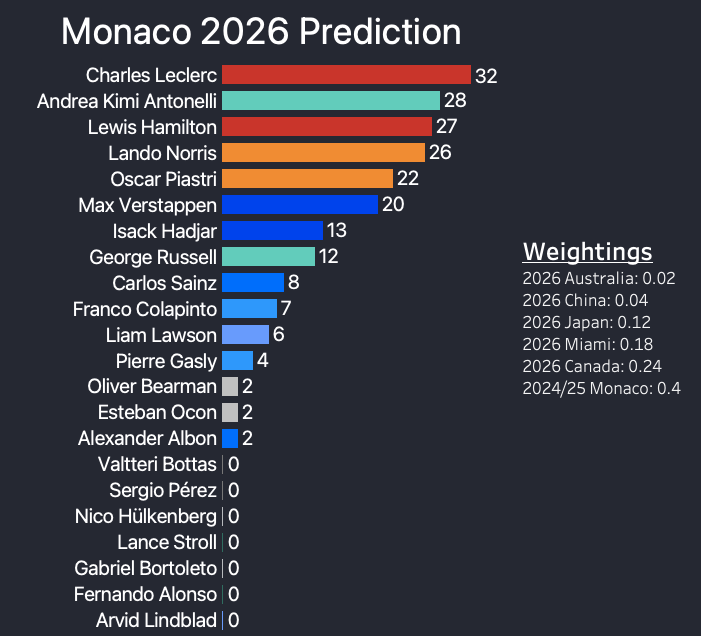
The updated model produces a familiar group of contenders at the front, but with a slightly different order. Charles Leclerc leads the projections with a Drive Score of 32, narrowly ahead of Kimi Antonelli (28), Lewis Hamilton (27), and Lando Norris (26). Behind them sit Oscar Piastri, Max Verstappen, Isack Hadjar, and George Russell, rounding out a familiar projected top eight.
One of the more interesting results is Russell's position. Despite his strong form throughout 2026, the model places him eighth overall, suggesting that his recent Monaco history is pulling his score down. Russell finished fifth in Monaco in 2025 and eleventh in 2024, results that become much more significant under the increased historical weighting.
That makes Monaco an especially intriguing weekend in the championship battle. Antonelli enters with both the momentum and the model's confidence, while Russell faces a circuit where the numbers are less convinced. How those two perform could provide another important clue about where the title fight is headed.
We're rolling out a new offering called You, Inc. which provides athletes a framework to help them develop their professional sports careers.
Looking Ahead to Monaco
Canada provided another valuable test for the Drive Score. While unexpected strategy decisions, changing weather conditions, and multiple retirements reshaped the final results, the model once again showed promise by correctly identifying Antonelli as the race winner and accurately projecting the drivers who would occupy the front of the grid.
Now, the focus shifts to Monaco, one of Formula 1's most unique and iconic venues. With overtaking notoriously difficult and qualifying often determining the outcome of the race, historical performance carries more weight here than at almost any other circuit on the calendar. That's what led to the creation of Drive Score Version 5.0 and the increased emphasis on past Monaco results, a change that ultimately pushed Charles Leclerc to the top of the model's projections heading into race weekend.
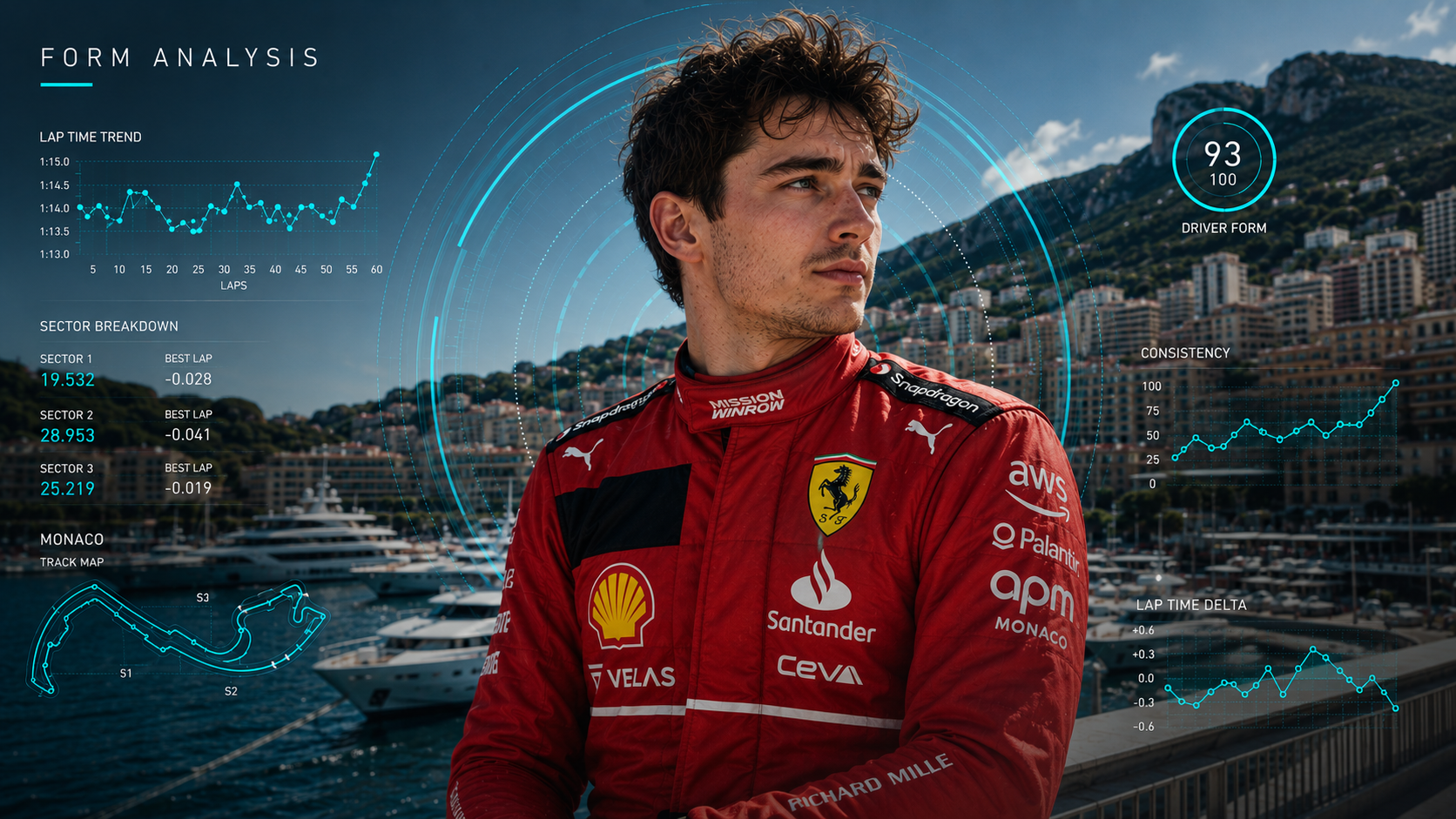
The championship picture continues to evolve as well. Antonelli arrives in Monaco riding a four-race winning streak and holding a growing advantage over teammate George Russell, while Ferrari, McLaren, and Red Bull still remain firmly in the fight. With the margins at the front becoming increasingly tight, Monaco may provide one of the clearest tests yet of whether the Drive Score is capturing the true competitive order of the grid.
Following the Monaco Grand Prix, we'll return to evaluate how Version 5.0 performed, identify what it got right (and wrong), and continue refining the model as the 2026 season unfolds.