
Within the Numbers Series #8
Drive Score Version 5.0
Following the Canadian Grand Prix, we introduced the Drive Score Version 5.0, marking another evolution of the model based on what we had learned through the first five races of the season. Monaco presented a unique challenge for the Drive Score metric, with overtaking opportunities limited and qualifying often determining the outcome of the race, historical performance at Monaco felt more important than it would at a typical circuit. That led to the creation of Drive Score 5.0, which increased the emphasis on past Monaco results to test whether track history could outperform current form.
As a result, we increased the weighting of historical track performance from 20% to 40%, while reducing the 2026 race component from 80% to 60%. The updated model consisted of:
- 60% weighted 2026 race performance
- 40% average Drive Scores from the 2024 and 2025 Monaco Grand Prixs
Within the 2026 season component, race results continued to be weighted by recency, with Canada carrying the greatest influence, followed by Miami, Japan, China, and Australia. The goal was to determine whether Monaco's unique characteristics would reward recent form or whether track history would prove to be the more valuable predictor. Heading into the Monaco Grand Prix, the model projected the following top contenders:
- Charles Leclerc (Ferrari) – 32
- Andrea Kimi Antonelli (Mercedes) – 28
- Lewis Hamilton (Ferrari) – 27
- Lando Norris (McLaren) – 26
- Oscar Piastri (McLaren) – 22
- Max Verstappen (Red Bull) – 20
- Isack Hadjar (Red Bull) – 13
- George Russell (Mercedes) – 12
While 20 points separated first and eighth, just six points separated the top four drivers, highlighting how competitive the battle at the front appeared heading into Monaco. Leclerc emerged as the favourite thanks to his strong Monaco history, while Antonelli entered the weekend carrying the momentum of four consecutive victories this season. The positioning of Russell was perhaps the most surprising result, suggesting that despite his strong 2026 form, his previous Monaco performances could make this a difficult weekend in what was becoming an increasingly important championship battle.
Check out our Instagram site for regular updates and posts on data-driven sports stories.
How Did Drive Score Version 5.0 Perform in Monaco?
Qualifying in Monaco provided another reminder of just how strong Antonelli has become, with the Mercedes driver securing pole position and continuing his dominant run of form. Verstappen had an impressive qualifying lap to secure second place on the grid, lining up alongside Antonelli on the front row. Ferrari showed the track-specific strength that helped make Leclerc the favourite in our Drive Score 5.0, with Hamilton and Leclerc qualifying third and fourth. Hadjar delivered another strong Red Bull performance coming in fifth, while George Russell could only manage sixth, further supporting the model's concerns about his recent Monaco results. Meanwhile, McLaren endured a difficult session, with Norris and Piastri qualifying seventh and eighth despite entering the weekend among the model's top-rated contenders.
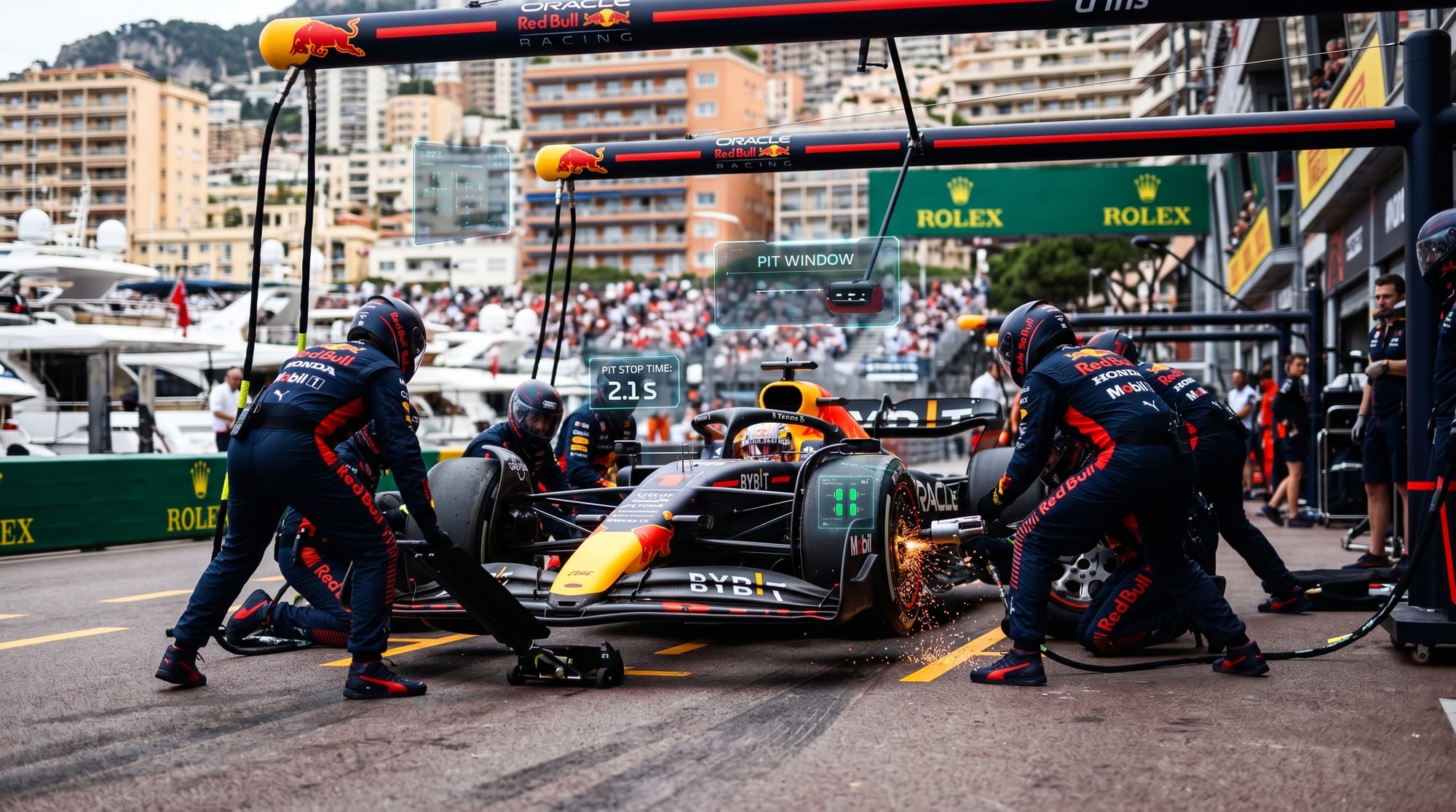
When the lights went out in Monaco, the dynamic of the race changed almost immediately. After qualifying second, Max Verstappen suffered a power unit issue off the line, causing his Red Bull to stall and forcing him to retire before his race even started. His early exit promoted both Ferraris into second and third, putting the top three drivers from the model's predictions into the top three spots. Monaco's reputation for limited overtaking opportunities once again proved true, with little movement throughout the opening stages.
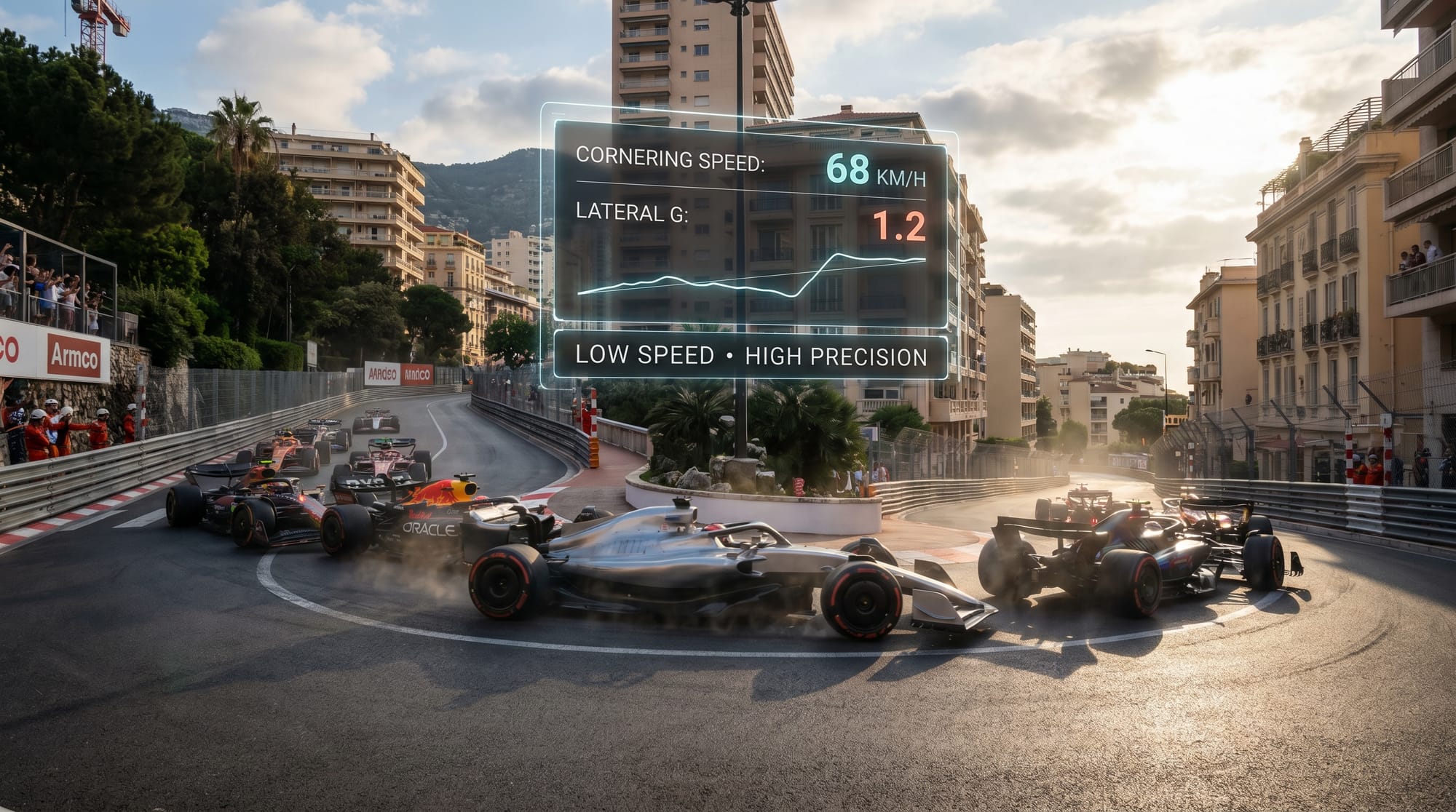
The next major storyline came when Lando Norris retired with an electrical power unit issue, marking his second consecutive race retirement. Later, Lance Stroll crashed on Lap 60, bringing out a Safety Car that lasted until Lap 65. Just moments after racing resumed, Charles Leclerc crashed in the same section of the circuit at Turn 19, triggering another Safety Car before race control eventually red-flagged the event on Lap 68 as officials repaired damage to the track surface. Following the restart, the field completed the final ten laps under regular racing conditions, although a number of penalties would ultimately shuffle the order behind the leaders after everyone had crossed the finish line.
The final top eight finishers were:
- Kimi Antonelli (Mercedes) – 2:23:31.243
- Lewis Hamilton (Ferrari) – +6.271s
- Isack Hadjar (Red Bull) – +23.394s
- Oscar Piastri (McLaren) – +24.261s
- Liam Lawson (Racing Bulls) – +26.553s
- Arvid Lindblad (Racing Bulls) – +29.010s
- Pierre Gasly (Alpine) – +30.369s
- Alexander Albon (Williams) – +33.413s
For Antonelli, the victory marked his fifth consecutive Grand Prix win, further extending his championship lead and reinforcing his status as the clear favourite of the 2026 season. The race also helped answer the central question that shaped Drive Score 5.0: would Monaco's unique characteristics reward track history or current form? While the battle proved to be quite close, Antonelli's victory suggests that current form ultimately carried greater predictive value. Despite Leclerc entering the weekend as the model's favourite due to his strong Monaco history, Antonelli's continued dominance and momentum from recent races once again proved decisive.
The model appeared relatively promising after qualifying, with three of its top projected drivers occupying the top three positions for much of the race. However, Leclerc's crash, retirements for both Norris and Verstappen, and multiple penalties handed out to Russell, all combined to dramatically alter the final results.
While the finishing order did not fully reflect the model's projections, the race once again demonstrated that Drive Score 5.0 was identifying the right contenders before a series of unpredictable incidents reshaped the outcome. As was the case in Canada, the underlying signal remains promising even if the final results failed to tell the whole story.
Want to see more sports stories? Explore the projects and sports stories published on Stories.
What's the Next Iteration for Our Drive Score Metric?
With six races now completed, we're making another adjustment heading into Spain. One of the biggest changes is the removal of the Australian Grand Prix from the model entirely. As the opening race of the season, Australia is now five races removed from the current championship picture, and its influence on the model had become increasingly limited. Rather than continuing to dilute the weighting across every race, we chose to focus on the five most recent events, which we believe provides a more accurate reflection of current driver and team performance.
The updated model allocates 80% of its weighting to recent race results and 20% to historical performance at the Spanish Grand Prix. Within the 2026 results, more recent races receive greater influence, with Monaco carrying the largest weighting and China the smallest. The updated weighting structure and Drive Score Version 6.0 predictions can be seen below:
- 40% Monaco 2026
- 30% Canada 2026
- 15% Miami 2026
- 10% Japan 2026
- 5% China 2026
- 20% Average Drive Scores from the 2024 & 2025 Spanish Grand Prix
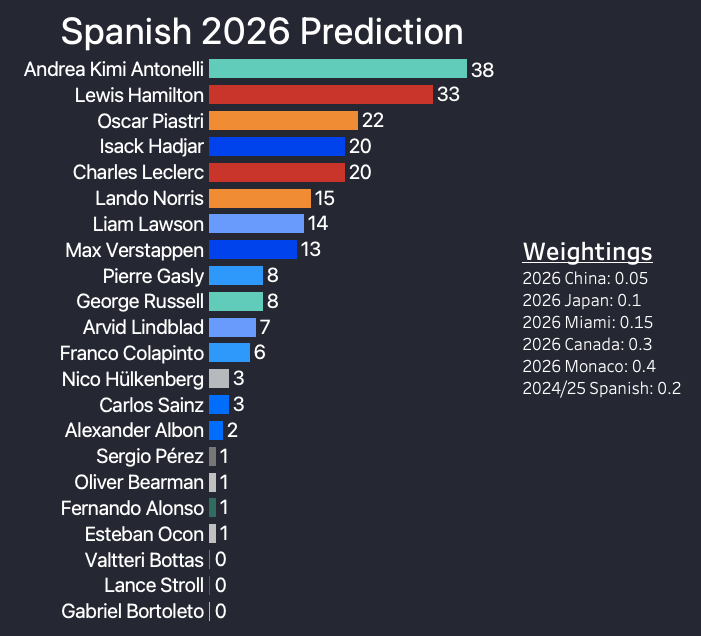
The resulting projections once again place Kimi Antonelli at the top of the field with a score of 38, continuing a trend that has persisted throughout much of the season. Lewis Hamilton follows in second at 33, while Oscar Piastri (22), Isack Hadjar (20), and Charles Leclerc (20) round out the next tier of contenders. Further back, Lando Norris (15), Liam Lawson (14), and Max Verstappen (13) complete the model's top eight.
The most surprising result is George Russell, who sits tied for ninth with Pierre Gasly at just eight points. After opening the season with a victory in Australia, Russell has endured a difficult stretch that includes a DNF in Canada and a 12th-place finish in Monaco. With Australia now removed from the model and recent races carrying greater weight, those results have had a significant impact on his projection heading into Spain.
The most notable takeaway comes from what we learned in Monaco. Looking back at the results, had we maintained the historical weighting at 20% rather than increasing it to 40%, the model would have projected Antonelli and Hamilton as the top two drivers heading into the race, which ultimately matched the final result. While one race does not provide a definitive answer, it suggests that current form may still be the strongest signal available, even at circuits where historical performance is traditionally viewed as highly important. This doesn't mean track history is unimportant, but rather that recent form should remain the foundation of the model moving forward.
We're rolling out a new offering called You, Inc. which provides athletes a framework to help them develop their professional sports careers.
Looking Ahead to Spain
After two consecutive races shaped by retirements, crashes, penalties, and changing conditions, the Spanish Grand Prix presents an opportunity to evaluate Drive Score 6.0 under hopefully more stable circumstances. Unlike Monaco, where qualifying and track position often dictate the outcome, Barcelona has traditionally provided a more complete test of both car performance and race pace.
The updated model once again identifies Andrea Kimi Antonelli as the driver to beat, with Lewis Hamilton emerging as his closest challenger. However, several familiar names remain within striking distance, including Oscar Piastri, Charles Leclerc, Lando Norris, and Max Verstappen. With the field continuing to evolve and recent form carrying greater influence than ever before, Spain will provide another valuable test of whether Drive Score 6.0 is moving closer to capturing the true competitive order of the grid.

