
Within the Numbers Series # 29
A Reputation Built on Chaos
The Brazilian Grand Prix has built quite the reputation over the years. From unpredictable weather, dramatic comebacks, and races that seem to turn upside down in a matter of laps, São Paulo has become one of the most exciting races in the Formula 1 season. But just how much of that reputation is actually backed up by the numbers?
To find out, we took a look at how much drivers moved between their starting and finishing positions across 19 Formula 1 circuits from 2015 to 2025. The results suggest that Brazil's reputation isn't entirely exaggerated. On average, drivers at Interlagos gained or lost 3.29 positions per race, placing the circuit second on the list, behind only Russia at 3.44.
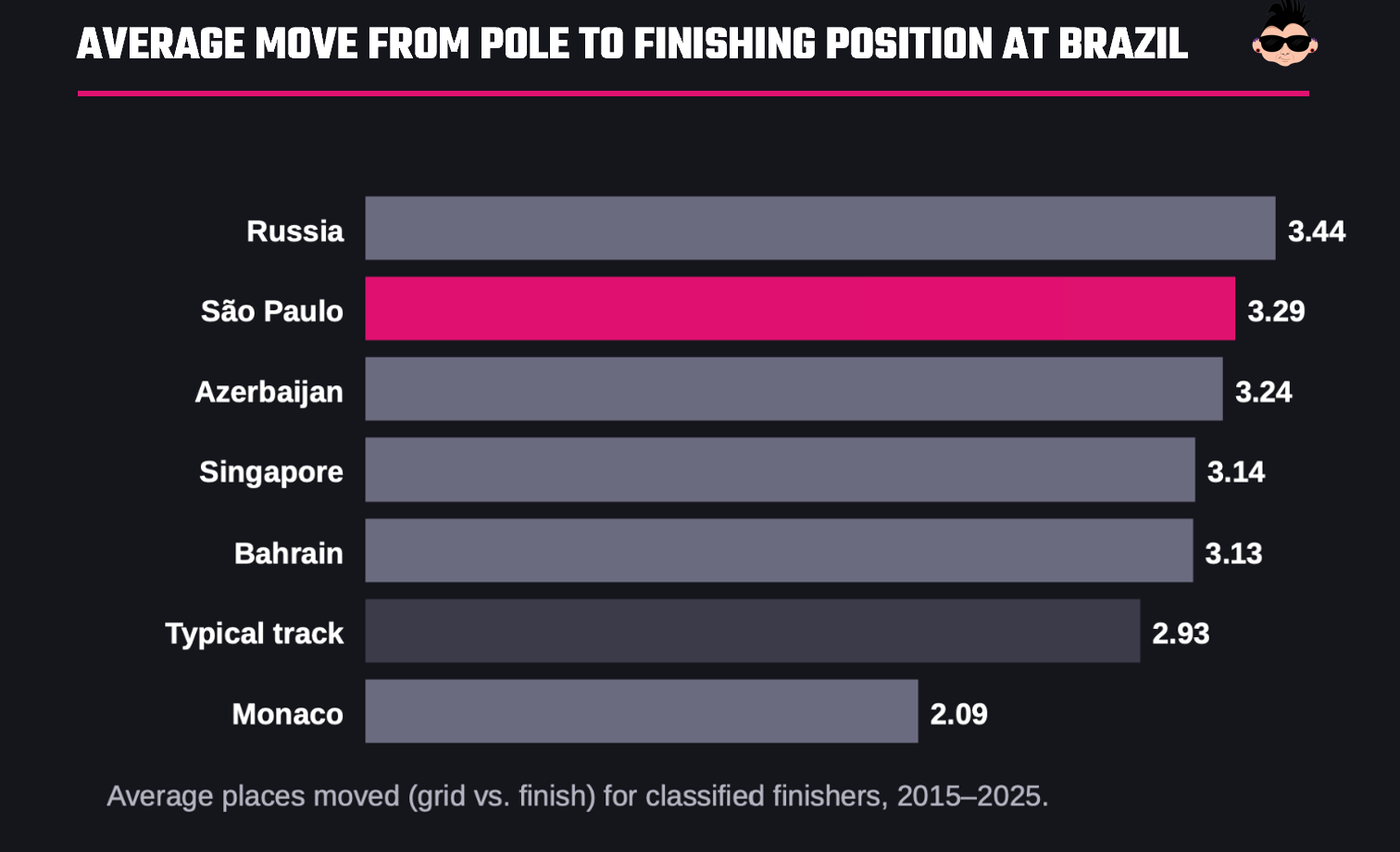
However, there's an interesting catch. Across the circuits examined, the typical average movement was 2.93 positions, meaning Brazil wasn't actually that far ahead of the other tracks that we looked at. While Interlagos certainly ranks among the more unpredictable circuits, the numbers suggest that its reputation for chaos might have more to do with a handful of extraordinary performances than what happens during a typical race.
Where Comebacks Become Legendary
A couple of the best examples of this are Max Verstappen and Lewis Hamilton, who both managed to turn difficult starting positions into race victories.
In 2024, Verstappen started in 17th before making his way through the field to take the win. Hamilton pulled off something similar in 2021, climbing from 10th on the grid to first place. Both performances earned a Drive Score of 101, the highest recorded at Interlagos during the period examined.
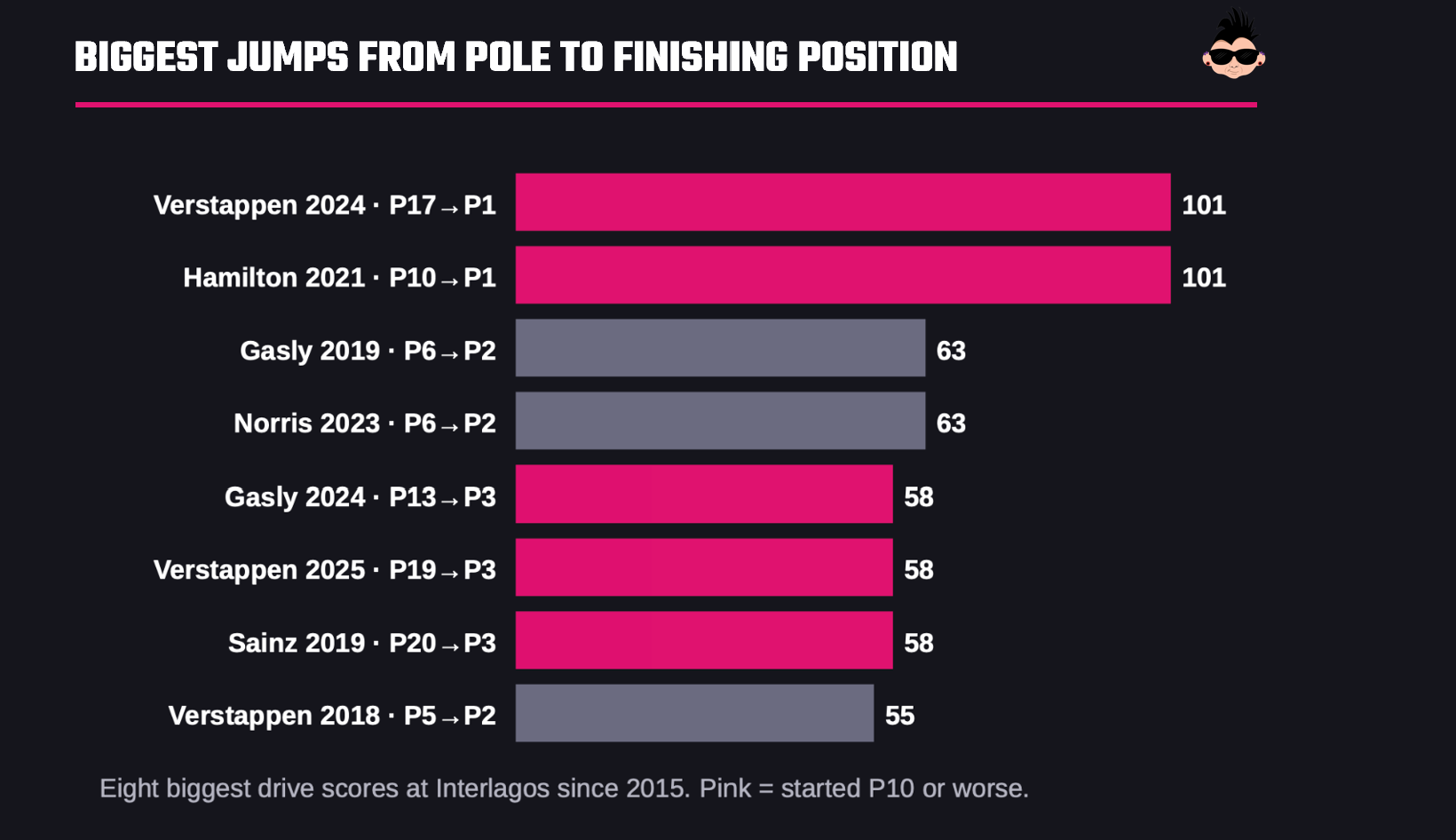
And there's plenty more examples where these came from. Five of the eight highest Drive Scores recorded in Brazil between 2015 and 2025 came from drivers who started 10th or lower on the grid. Pierre Gasly's third place finish from 13th in 2024, Carlos Sainz's podium from 20th in 2019, and Verstappen's climb from 19th to third in 2025 all produced Drive Scores of 58.
These performances can help to explain why Brazil has earned such a reputation for unpredictability. While the average race doesn't look dramatically different from other circuits, Interlagos has still repeatedly provided opportunities for drivers to turn a difficult starting position into something worth tuning in for.
The Two Sides of Brazil
But there's still another side to this circuit that might come as a surprise. Seven of the last ten Brazilian Grand Prix winners actually started from pole position, suggesting that the race itself has been a little more predictable than its reputation might lead you to believe.
However, looking beyond the race winners reveals a much different picture. Drive Score shows just how much a driver's performance can vary from one visit to Brazil to the next. Lewis Hamilton, for example, has recorded scores ranging from -9 all the way up to 101, while Max Verstappen has seen a similarly wide range, from 1 to 101. Lando Norris has experienced plenty of variation himself, with scores ranging from -22 to 63.
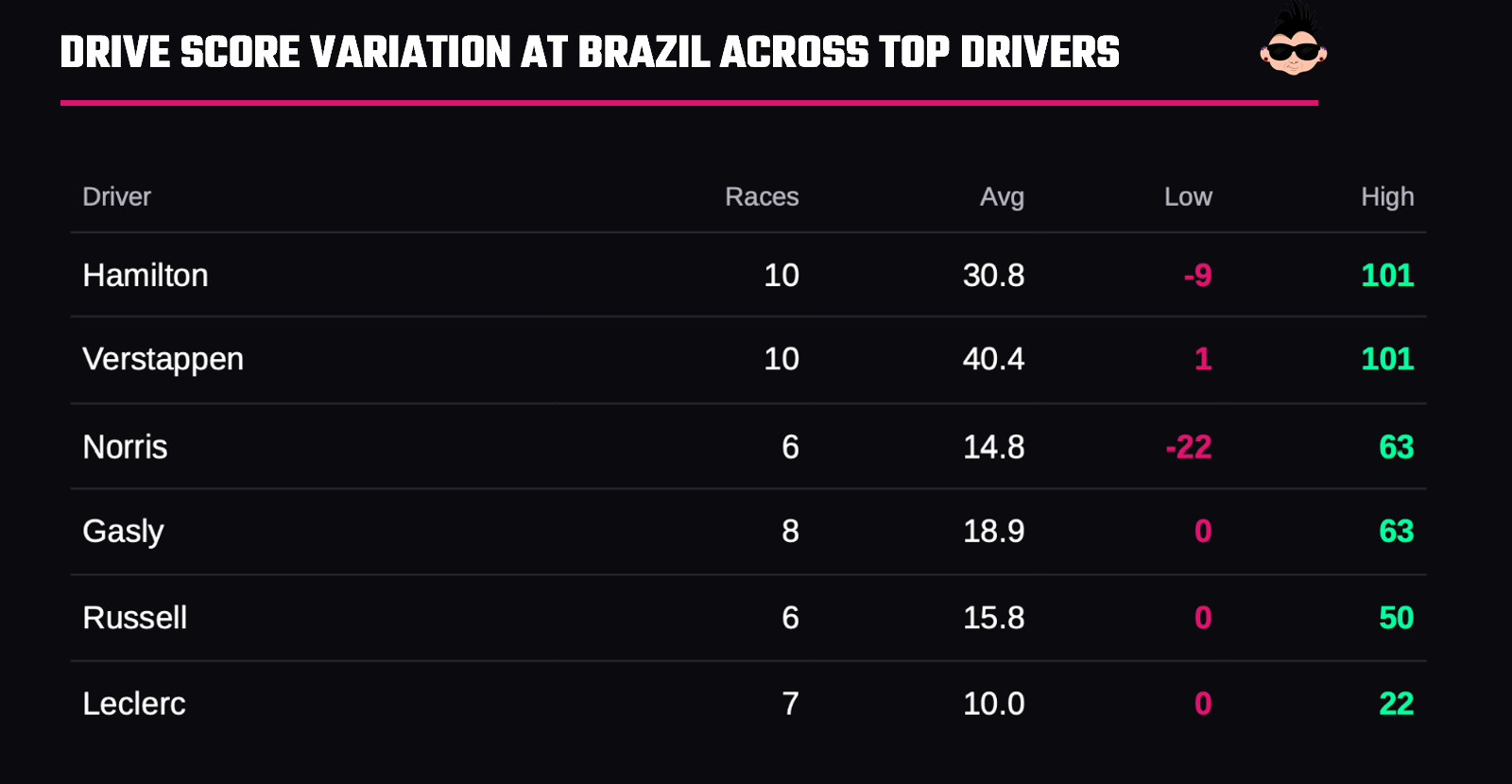
Looking at other drivers like Gasly, Russell and Leclerc, it's clear that these dramatic swings in performance aren't limited to just a handful of drivers or teams.
That's what makes Brazil such an interesting race to analyze. While the winner might often come from the front of the grid, the performances happening behind them sometimes tells a completely different story.
Brazil Through the Eyes of Drive Score
Keeping all that in mind, it's time to turn our attention to what Drive Score expects from this year's Brazilian Grand Prix. And according to this year's predictions, one driver stands out quite a bit from the rest of the field.
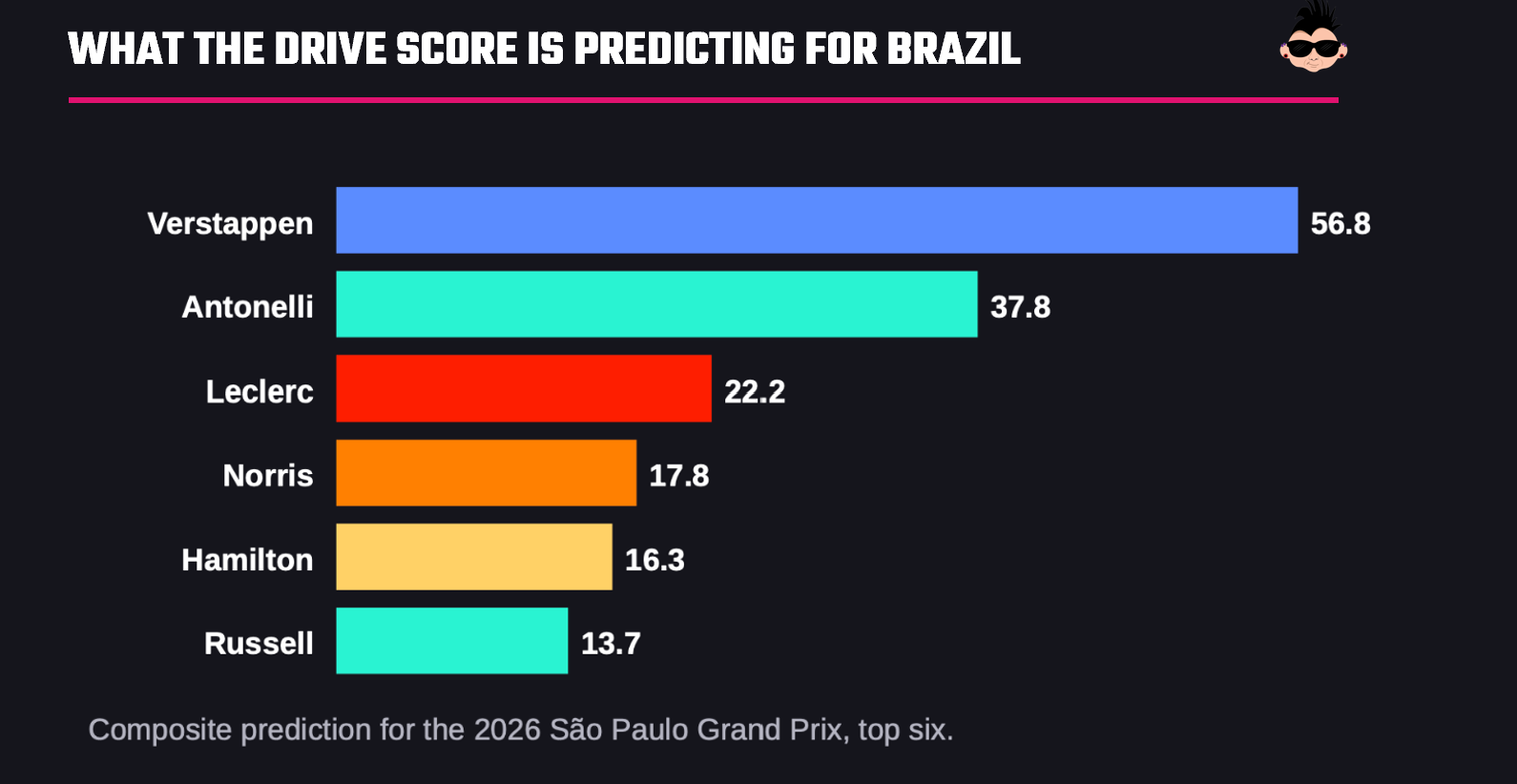
Max Verstappen enters the race as Drive Score's clear favorite, with a predicted Drive Score of 56.8. That's a considerable lead over newly crowned World Champion Kimi Antonelli, who sits second with a predicted score of 37.8. Charles Leclerc rounds out the top three at 22.2, followed by Lando Norris at 17.8, Lewis Hamilton at 16.3, and George Russell at 13.7.
Verstappen's position at the top is particularly prominent given his history at this circuit, including his remarkable victory from 17th in 2024. With another strong prediction heading into this year's race, the model suggests he's well positioned to deliver another standout performance.
Of course as we've seen throughout this newsletter, Brazil has a way of producing results that don't always follow expectations. While Verstappen might have the strongest Drive Score prediction on paper, there's still plenty of room for someone else to make their mark. And with the fight for second place in the Drivers' Championship still incredibly close between George Russell, Lewis Hamilton, Max Verstappen and Charles Leclerc, there's a lot at stake heading into Brazil.
The Hits and Misses From Mexico
Before wrapping things up, we want to take a quick look back at last weekend's Mexican Grand Prix to see how our Drive Score's predictions compared to the actual race results.
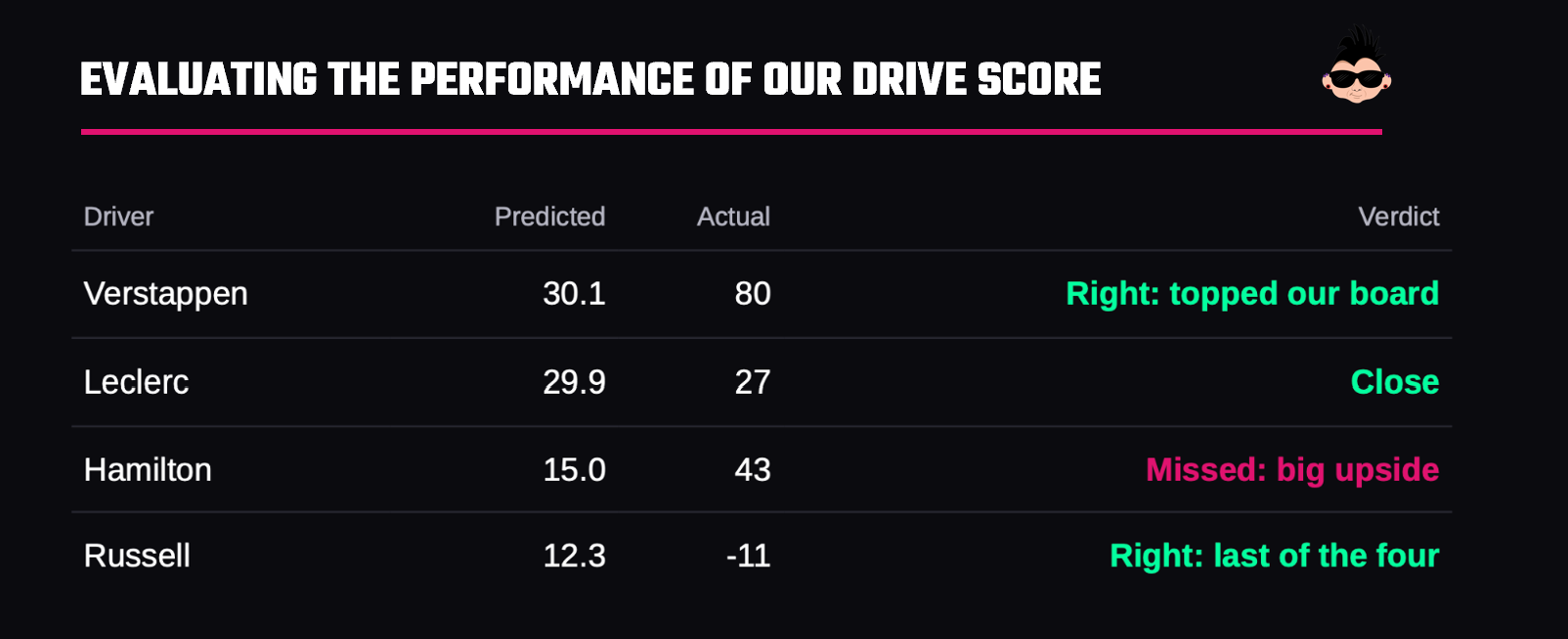
Max Verstappen was one of the model's biggest surprises, although not necessarily in terms of where he finished. Drive Score had him leading the four drivers we're comparing with a predicted score of 30.1, but his race-winning performance produced an actual score of 80. Lewis Hamilton also exceeded expectations, recording a Drive Score of 43 compared to his prediction of just 15.0, following his second-place finish.
On the other hand, Charles Leclerc came remarkably close to his prediction, finishing with a Drive Score of 27 against a projected 29.9. George Russell had a much tougher outing, recording a score of -11 compared to his prediction of 12.3.
Overall, Mexico was a bit of a mixed bag for Drive Score. The model correctly placed Verstappen at the top and Russell at the bottom of these four drivers, but it underestimated just how strong Verstappen and Hamilton would be.
Looking Ahead to Brazil
With the Brazilian Grand Prix lights about to go out, all eyes will be on whether Interlagos can deliver another one of the memorable races it's become known for. The numbers suggest that while the front of the grid in Brazil might not be quite as chaotic as the circuit's reputation would suggest, there's no shortage of examples showing just how unpredictable things can get further down the field.
Drive Score has Max Verstappen leading the predictions heading into the race, but with several drivers capable of producing standout performances and the battle for second place in the championship still wide open, there's plenty to keep an eye out for on Sunday.

