
Within the Numbers Series # 10
Drive Score Version 6.0
With six races complete heading into Spain, Drive Score 6.0 represented the latest evolution of the model as we continued to learn which factors provided the strongest signals throughout a Formula 1 season.
One of the biggest changes heading into Spain was the removal of the Australian Grand Prix from the model. As the season opener, Australia sat several races removed from the current championship picture, making it less representative of the form teams and drivers had been showing in recent races. Instead, the model focused on the five most recent race weekends while continuing to incorporate a smaller historical component from previous Spanish Grand Prix performances.
The weighting structure and resulting driver projections can be seen below.
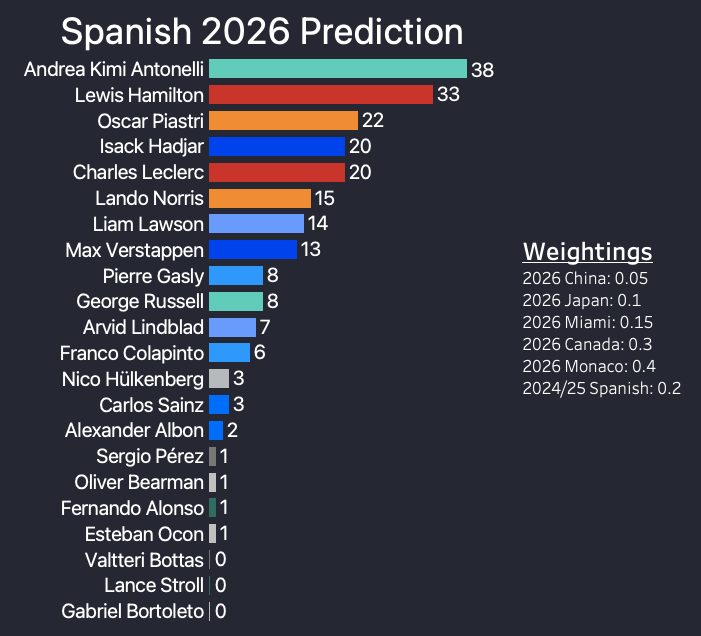
The updated model once again placed Andrea Kimi Antonelli at the top of the field, continuing a trend that had emerged throughout much of the season. Despite adjustments to the weighting structure and the removal of Australia from the model, Antonelli remained the clear favourite heading into Spain. Behind him sat a tightly grouped collection of Ferrari, McLaren, and Red Bull drivers, suggesting the battle for the remaining podium positions remained highly competitive.
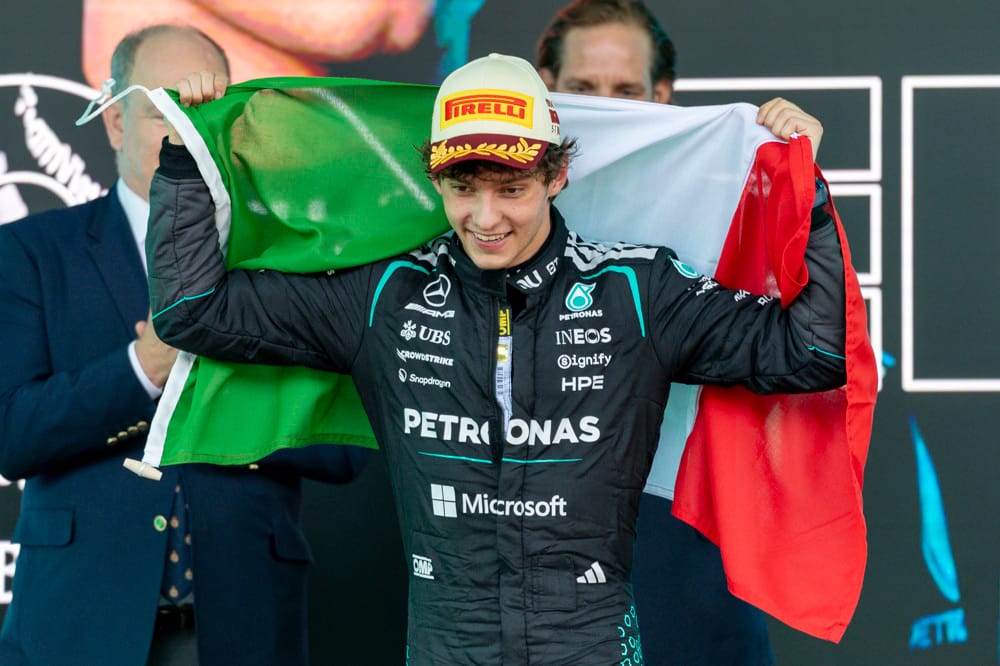
One of the more notable projections was George Russell's position further down the rankings. With recent results carrying more influence than ever before, Russell's difficult stretch of races had a significant impact on his outlook heading into Spain. Meanwhile, Antonelli's continued success only strengthened the model's confidence in him as the benchmark driver on the grid.
As the season progressed and the sample of race data continued to grow, the Drive Score became increasingly focused on current form rather than early-season expectations. Spain presented another opportunity to evaluate whether that approach was accurately capturing the competitive order of the field, and whether Antonelli's sustained dominance was truly as clear as the model suggested.
Interested in taking one of our live workshops on Sports, AI and Storytelling? Then check out our Offerings page.
What Happened in Qualifying?
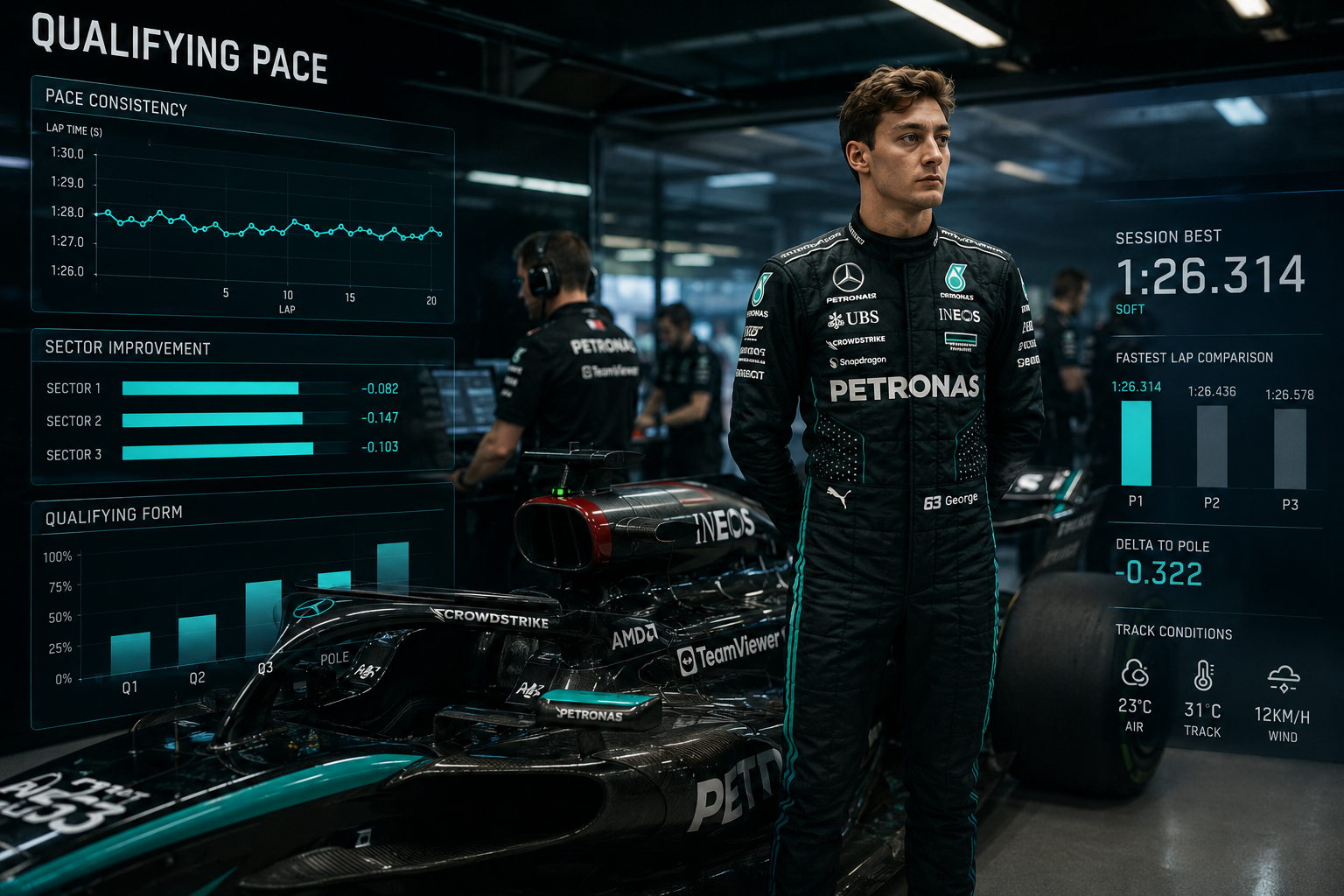
Qualifying in Barcelona provided one of the first major surprises of the weekend. Despite ranking much lower in Drive Score 6.0, George Russell delivered an outstanding performance to secure pole position. After a difficult stretch that included a DNF in Canada and a penalty-filled Monaco weekend, Russell's pace suggested that his recent results may have been influenced as much by circumstance as outright performance. Lewis Hamilton's second-place qualifying result aligned closely with the model's expectations, while Antonelli secured third and remained well-positioned heading into race day. Further down the grid, several familiar contenders rounded out the top ten:
- George Russell (Mercedes)
- Lewis Hamilton (Ferrari)
- Andrea Kimi Antonelli (Mercedes)
- Lando Norris (McLaren)
- Max Verstappen (Red Bull)
- Isack Hadjar (Red Bull)
- Oscar Piastri (McLaren)
- Liam Lawson (Racing Bulls)
- Nico Hülkenberg (Audi)
- Charles Leclerc (Ferrari)
Perhaps the most notable difference between qualifying and the model's projections was Leclerc, who entered the weekend as the fifth-highest rated driver in Drive Score 6.0 but could only manage 10th on the grid. Meanwhile, Russell's pole position served as a reminder that while the model places significant emphasis on recent form, individual performances can still challenge the trends established over the course of a season.
Check out our Instagram site for more sports stories and F1 coverage.
How Did the Race Actually Unfold?
For much of the Spanish Grand Prix, the race unfolded almost exactly as the qualifying order suggested. Russell, Hamilton, Antonelli, Norris, and Verstappen occupied the top five positions for the majority of the race, with strategy and pit stops becoming the primary battleground as high track temperatures forced teams to carefully manage their tyres.
After leading much of the opening half of the race, both Mercedes drivers made their scheduled pit stops within a few laps of one another, allowing Hamilton to inherit the lead. The turning point came on Lap 41 of 66 when Fernando Alonso was forced to retire his Aston Martin, triggering a Virtual Safety Car. The timing proved extremely fortunate for Ferrari, allowing Hamilton to complete his pit stop and rejoin the race before the two Mercedes drivers could cycle back through. From that point forward, Hamilton controlled the race and never relinquished the lead.
Late drama arrived in the closing stages. On Lap 61, Antonelli overtook Russell and appeared set to secure second place behind Hamilton. However, just one lap later, Antonelli suffered a sudden electrical shutdown and was forced to retire with only four laps remaining. The retirement promoted Russell back into second place and moved Norris onto the podium in third.
The misfortune did not stop there. Charles Leclerc, who had recovered from his disappointing qualifying result and was running behind Verstappen in 6th at the time, suffered a power steering failure on the same lap as Antonelli's retirement and was also forced out of the race. As a result, Verstappen inherited fourth position while Oscar Piastri moved into fifth. The top ten finishers and their time behind Hamilton can be seen below:
- Lewis Hamilton (Ferrari) - 1:32:28.105
- George Russell (Mercedes) +19.561s
- Lando Norris (McLaren) +23.719s
- Max Verstappen (Red Bull) +40.497s
- Oscar Piastri (McLaren) +58.661s
- Isack Hadjar (Red Bull) +1 lap
- Pierre Gasly (Alpine) +1 lap
- Liam Lawson (Racing Bulls) +1 lap
- Arvid Lindblad (Racing Bulls) +1 lap
- Franco Colapinto (Alpine) +1 lap
Even accounting for the fortunate timing of the Virtual Safety Car, Hamilton demonstrated exceptional pace throughout the weekend. His nearly 20-second victory over Russell served as another reminder that both Ferrari and Hamilton remain firmly in the championship conversation. From a Drive Score perspective, Spain provided another encouraging result. While Russell's pole position made him an outlier relative to the model's projections, Drive Score 6.0 once again identified the key contenders at the front of the field. In fact, the model's top two projected drivers occupied the top two positions for much of the race before Antonelli's late retirement altered the final classification.
Spain may have also provided one of the most interesting tests of Drive Score 6.0 so far. Antonelli's retirement prevented the model's highest-rated driver from converting another strong performance into a victory, despite spending much of the weekend near the front of the field. While he still holds a commanding 41-point lead in the Drivers' Championship and remains the benchmark driver in the model, Hamilton's victory and Russell's return to form suggests the gap to the rest of the grid may not be quite as large as recent results have indicated. It is far too early to draw definitive conclusions from a single race, but Spain raised an important question for the next iteration of the Drive Score: is Antonelli's dominance beginning to level off, or was this simply another example of an unpredictable result masking the true competitive order of the field?
The question now becomes: how will Drive Score 7.0 evolve heading into Austria?
Want to see more sports stories? Explore the projects and sports stories published on Stories.
Drive Score Version 7.0
Heading into the Austrian Grand Prix, Drive Score 7.0 will continue the model's recent emphasis on current form. Similar to Version 6.0, the model focuses on the five most recent race weekends while maintaining a smaller historical component from the 2024 and 2025 Austrian Grand Prix. With Austria marking the eighth race of the season, both Australia and China have now been removed from the weighting structure. As the first two races on the calendar, they are becoming increasingly less representative of the current competitive order compared to more recent results.
The weighting structure and resulting driver projections can be seen below.
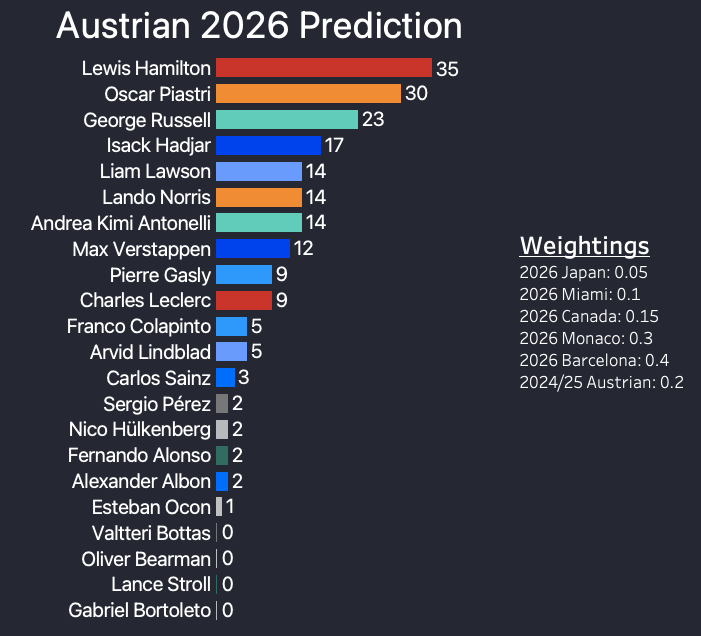
Lewis Hamilton of Ferrari enters Austria as the model's favourite following his victory in Spain, while McLaren's Oscar Piastri and George Russell from Mercedes round out the top three. The most surprising projection, however, is championship leader Andrea Kimi Antonelli, who sits tied with Lando Norris and Liam Lawson despite holding a 41-point lead in the Drivers' Championship.
This appears to be a clear outlier in the model. Antonelli's retirement in Spain carries significant weight because it was the most recent race, while his historical Austrian component also works against him after a DNF in 2025 and no Formula 1 experience in 2024. As a result, Austria will provide an interesting test of whether Drive Score 7.0 is identifying a genuine shift in the field or simply overreacting to a rare combination of circumstances affecting one driver.
Want to take your sports storytelling abilities to the next level? Be sure to get our new e-book entitled Sports, AI and Storytelling: A Primer.
Looking Ahead to Austria
Austria will provide another important test for the Drive Score metric as the model continues to place greater emphasis on recent performance while reducing the influence of older results. The updated weighting leaves Lewis Hamilton atop the projections, with Oscar Piastri and George Russell also expected to be strong contenders at the Red Bull Ring.
The biggest question mark surrounds championship leader Andrea Kimi Antonelli. Despite holding a 41-point lead in the Drivers' Championship, his retirement in Spain and limited historical success in Austria have pushed him well down the model's rankings. Whether that proves to be an overreaction to a single setback or an early sign that the field is beginning to close the gap will be one of the key storylines heading into the Austrian Grand Prix.

