
Within the Numbers # 12
Gavin McKenna was the consensus first overall pick in the 2026 NHL Draft, but our recent predictive model wasn't completely convinced. Using league-adjusted production, age, and other competitive factors, we compared the top prospects in the class to see how they stacked up statistically. The results offer a different perspective on one of the biggest decisions of draft night.
The Pick Everyone Expected
When the 2026 NHL Draft arrived, there was little suspense surrounding the first overall selection. Gavin McKenna had spent years establishing himself as the premier prospect in the class. His offensive production was exceptional, his skill set drew rave reviews from scouts, and his combination of vision, creativity, and hockey IQ made him the consensus choice to go No. 1. So when the Toronto Maple Leafs selected him with the first overall pick, it came as no surprise.
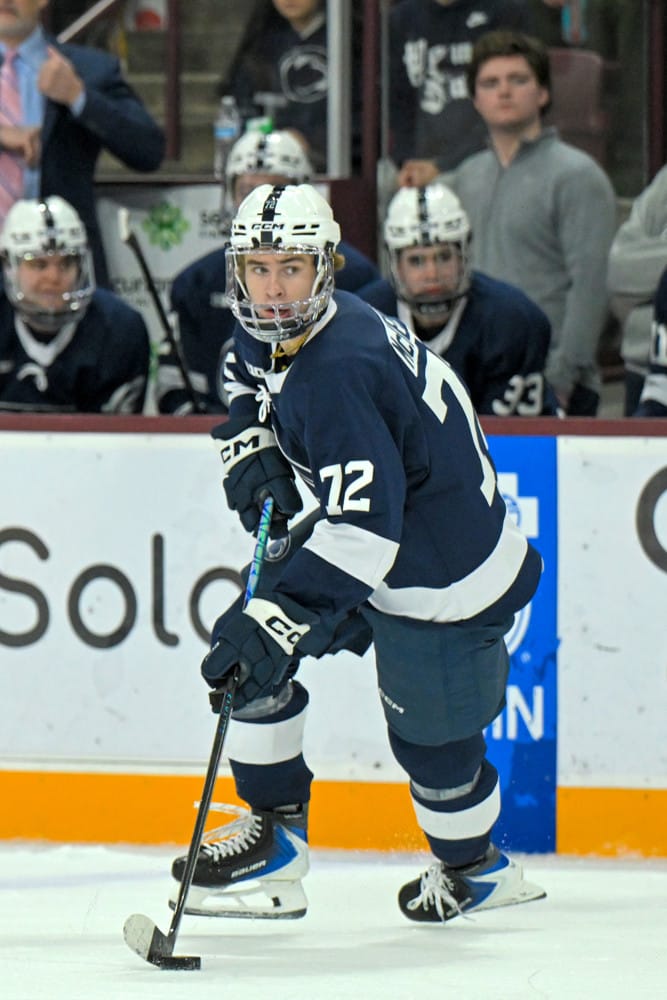
What was surprising, however, was that our predictive model saw the incoming prospect class a little differently. By exploring which statistical properties determine top-round picks (prospects that get drafted in Rounds 1 and 2), we discovered other, more unknown prospects ranked higher among the likes of McKenna.
This isn't an argument against Toronto picking McKenna; the Leafs need a jolt this year with which McKenna can help. Instead, it asks a simple question: if McKenna was the clear consensus No. 1 prospect, why didn't he rank first in our league-adjusted production model?
The answer isn't just about McKenna. It's about how different evaluation methods can lead to different conclusions. While scouts project what a player could become, our model evaluates what they've already accomplished relative to the competition they've faced. The gap between those two perspectives offers an opportunity to revisit one of the biggest decisions of the 2026 NHL Draft and ask whether the consensus was as clear-cut as it seemed.
Do you know an amateur athlete that wants to go pro? Check out our You, Inc. development framework – six dimensions to help young athletes prepare for a career in the pros.
The Case for McKenna
It's easy to understand why Toronto selected Gavin McKenna as the first overall pick. Few prospects combine elite production with the offensive skill set that scouts believe will translate to NHL success. Whether he's carrying the puck through the neutral zone, creating opportunities for teammates, or producing under pressure, McKenna has consistently shown an ability to drive offence in a variety of ways, and the numbers support that reputation.
McKenna finished the season with 51 points in 35 games at Penn State, production that would put nearly any prospect in the conversation for the top selection. Pair those numbers with his skating ability, hockey IQ, and long-term upside, and it's no surprise he entered the draft as the consensus No. 1 player. For many organizations, that was enough.
Toronto clearly believed McKenna possessed the highest ceiling in the class, making him the obvious choice to build around. Our model, however, approached the same draft class from a different perspective: it uses a league-adjusted production metric (NHLe) that inherently introduces league and regional bias into the math. In short, younger players coming from stronger leagues (closer to NHL play) such as the SHL and KHL feature higher in our model's ranking.
Check out our Learning hub, where you'll find a ton of great Sports, AI and Storytelling courseware. We update it regularly, and it's free for DPM members.
The Model's Rankings
Our model wasn't built to replicate public rankings or scouting reports. Instead, it evaluates offensive production after adjusting for the strength of the league each prospect played in. Using NHL Equivalency (NHLe), players from different leagues can be compared on a more level playing field by estimating how their production would translate against NHL competition.
Rather than asking who scored the most points, the model asks a different question: whose production was the most impressive given their age and the level of competition they faced?
By that measure, McKenna still grades out as one of the elite forwards in the 2026 draft class. His Adjusted Points per Game (Adj. PPG) of 0.283 places him firmly among the class's top prospects. But the biggest surprise is that he doesn't finish first.
Ivar Stenberg, who went second overall to San Jose, leads the class with an Adj. PPG of 0.434, while Czech forward Matej Kubiesa checks in just ahead of McKenna at 0.298. It's important to note that on raw production alone, McKenna's 51 points in 35 games comfortably outpace both players. Once league strength is incorporated, however, the picture changes considerably, and the scatter plot below illustrates that shift.
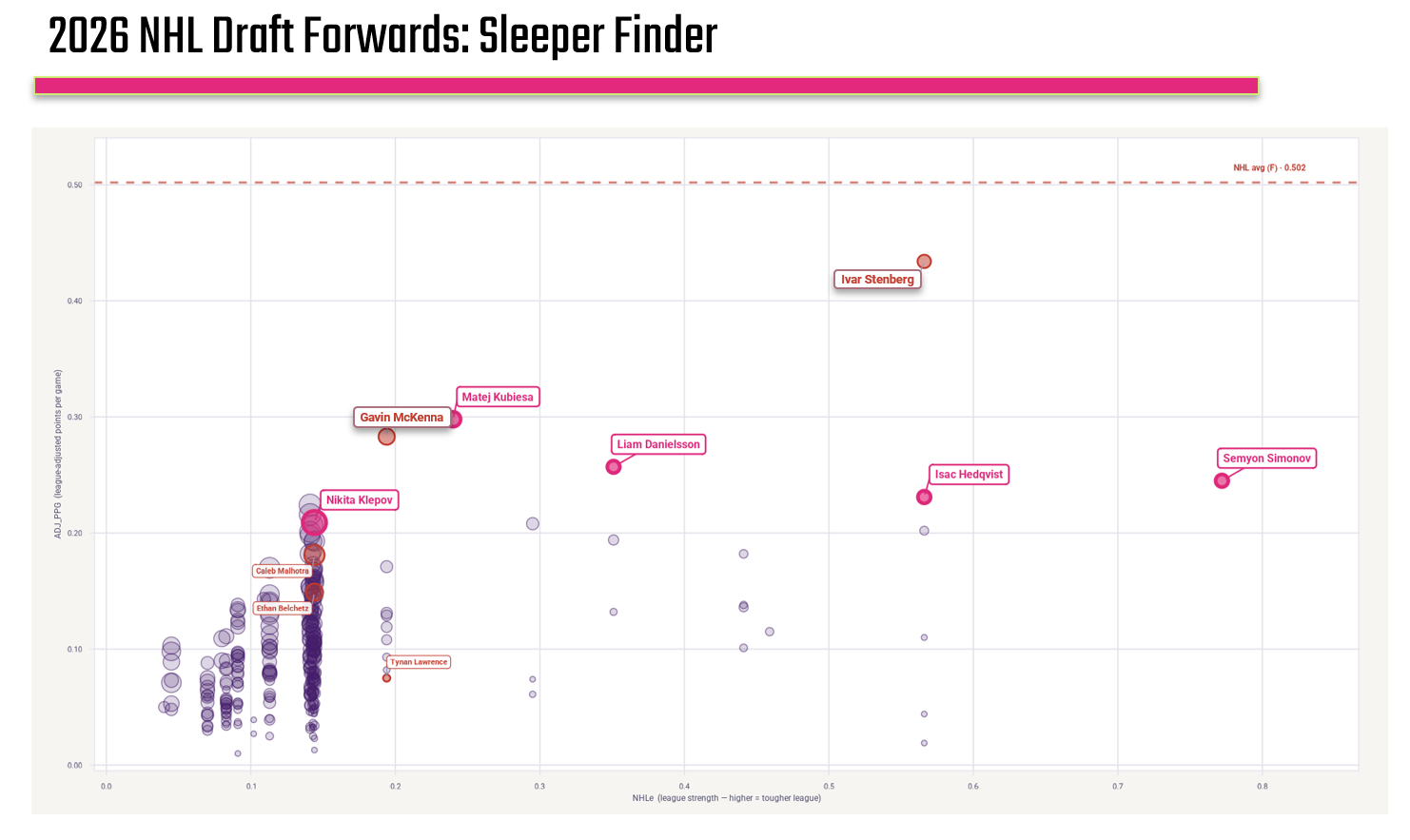
McKenna remains one of the draft's premier offensive prospects, but he isn't standing alone at the top of the rankings. Instead, Stenberg emerges as the statistical leader, with Kubiesa also edging ahead once league strength is taken into account.
That doesn't necessarily mean Toronto should have selected Stenberg instead. What it does suggest is that the gap between McKenna and the rest of the class wasn't as wide as the public conversation often implied. While the draft ultimately followed the scouting consensus, the model viewed the race for first overall as much closer than many expected.
Enjoying the sports data stories? Be sure to check out our regular Within the Numbers series on our Data Stories page.
NCAA versus the SHL
Simply put: our model values age and competitive play higher than raw stats (and qualitative ratings). So why specifically didn't McKenna sit at the top of our model's rankings?
The answer largely comes down to the league he played in: the NCAA. McKenna's 51 points in 35 games at Penn State are undeniably impressive. The challenge is that those numbers came in the NCAA, a league with an NHLe value of 0.194. By comparison, Stenberg spent the season in the SHL, one of Europe's top professional leagues, which carries an NHLe value of 0.566. That difference has a significant impact on how the model evaluates production.
Our model is not isolated in its comparisons across leagues. For example, according to Jason Bakula from a SportsNet article published in 2022:
"The Swedish Hockey League (SHL) is one of the best pro leagues in the world outside of the NHL."
He goes on to add:
"I've concluded, over the years, that the SHL falls in line with the American Hockey League in terms of structure, competition, and overall preparation for developing prospects before they arrive in the NHL."
Further, Play Hockey in Europe – SHL vs NCAA D1 describes the SHL as "one of the premier ice hockey leagues in the world" where 1) many NCAA stars who eventually move to Sweden still require professional experience before they can earn SHL jobs and 2) only elite NCAA players are capable of reaching the SHL. This might explain why our predictive model included several Scandinavian sleeper prospects.

All of this does not mean the NCAA is a bad league; it's an amazing opportunity for young hockey players to develop themselves into potential pros. The differentiator here is that production in the SHL should be viewed through a different lens because draft-eligible players are competing against veteran professionals rather than primarily 18-to-23-year-old collegiate athletes. NHL scout Jason Bukala has argued that the SHL "falls in line with the American Hockey League" in terms of competition and player development, making offensive production by teenagers particularly difficult and particularly valuable to NHL evaluators.
Are you looking for deeper guidance on Sports, AI and Storytelling? Be sure to check out our What We Offer page for offerings and programs tailored to your needs.
What Should We Make of the Results?
So what should we make of a model that ranked Ivar Stenberg ahead of the player Toronto ultimately selected first overall? Simply put, the model places greater weight on production against older, professional competition. As a result, Stenberg's 33 points in 43 SHL games receive more credit than McKenna's 51 points in 35 games at Penn State once league strength is factored into the equation. The two seasons tell very different stories depending on which lens you choose to evaluate them through.
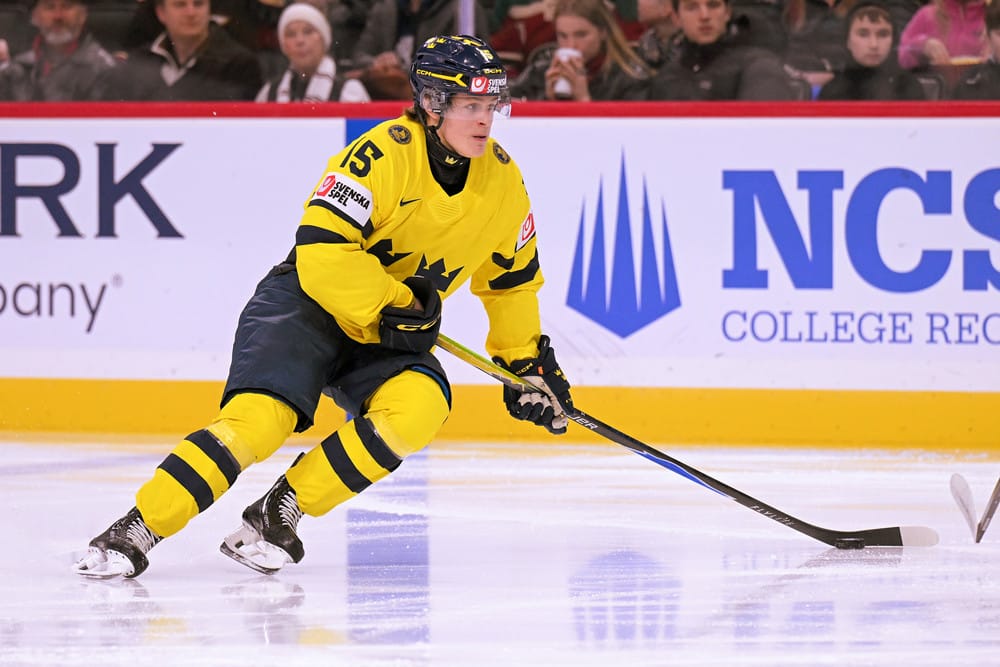
Looking strictly at raw production, McKenna appears to have had the more productive season. Once league strength is incorporated, however, Stenberg moves ahead in the model's rankings. That's not a flaw in the model, it's exactly how the model is designed to work.
You can disagree on whether that's the right approach. Supporters of the model would argue that producing against stronger competition is a better indicator of future NHL success. Others would point to McKenna's age, elite offensive toolkit, and long-term upside as reasons his NCAA production should carry just as much, if not more, weight. Toronto likely sided with the second perspective when they selected McKenna first overall.
That's why models like this shouldn't be viewed as draft boards. They're tools that provide another perspective on a prospect's profile and challenge assumptions that may already be accepted as fact. In this case, the model wasn't arguing that McKenna wasn't worthy of the No. 1 pick. Instead, it suggests that players like Stenberg and Kubiesa had production profiles that made the conversation closer than the public consensus suggested.
What is our recommendation? Use a variety of models to give scouts and analysts signal, so they can explore prospect performance and eligibility through broader prisms of evaluation.
Check out our newly published "Sports, AI and Storytelling: A Primer" for a deeper look on how to turn stats into stories.
What the Model Can't Measure
As useful as adjusted production can be, it doesn't tell the whole story. Statistics can measure what a player has accomplished, but they can't fully capture the traits that often separate good NHL players from great ones. Hockey sense, creativity, competitiveness, leadership, and the ability to elevate teammates are all qualities that remain difficult to quantify. Those are also many of the attributes that made Gavin McKenna the consensus top prospect in the 2026 draft class.
That's where scouting and analytics begin to answer different questions. Our model evaluates what a player has already accomplished relative to the competition they faced. Scouts, on the other hand, are projecting what that player could become five or ten years from now. Those aren't competing philosophies, they're complementary ones. Toronto's decision to select McKenna first overall reflects that distinction. While the model viewed players like Ivar Stenberg and Matej Kubiesa more favourably after adjusting for league strength, NHL teams aren't drafting past production alone. They're drafting future NHL players, and ultimately betting on which prospect has the greatest chance of becoming a franchise cornerstone.
That's the real value of a model like this. It isn't designed to replace scouting or declare who should have been drafted first overall. Instead, the model offers another perspective, highlighting prospects whose production may deserve a closer look and challenging assumptions that have become widely accepted.
McKenna ultimately became the first player selected in the 2026 NHL Draft, but that doesn't make the questions raised by the model any less valuable. If anything, it reinforces the importance of considering multiple ways to evaluate talent. Whether the consensus was right, or whether the numbers identified overlooked value elsewhere in the class, is a debate that won't truly be settled until these players begin writing their NHL careers.

